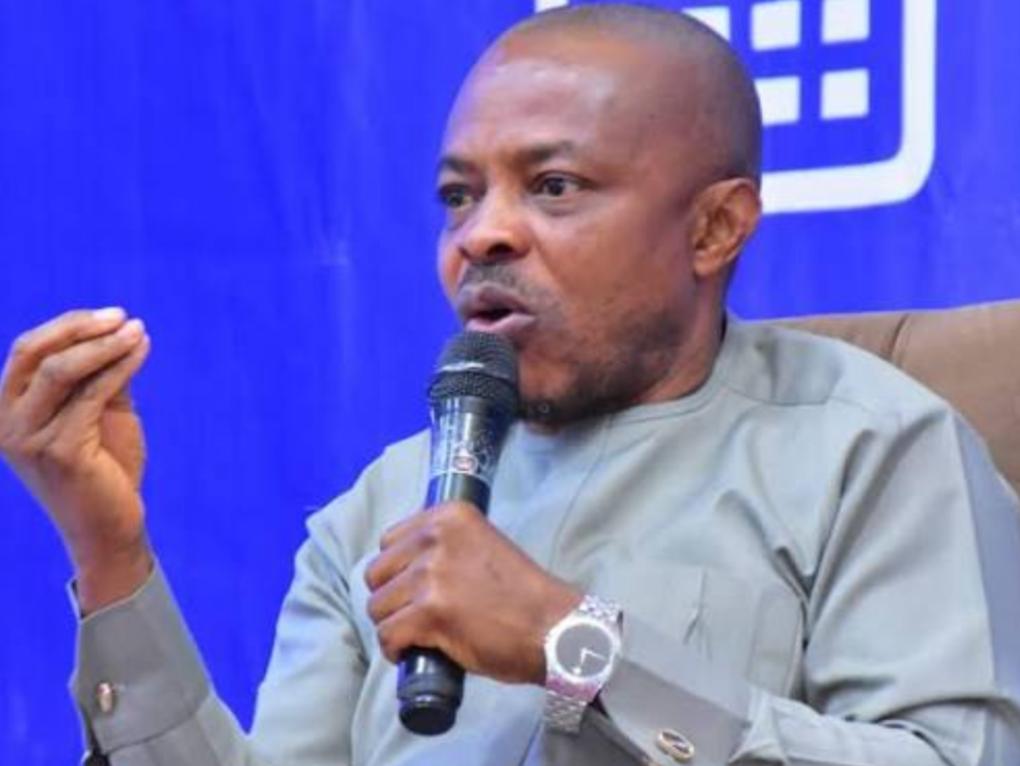
President of the Nigeria Labour Congress, Joe Ajaero, has described Nigeria’s power sector as “the biggest scam in the country,” accusing powerful interests of turning the industry into a profit-driven system that has failed to improve electricity supply despite years of privatisation and massive government spending.
In an interview, the NLC president and General Secretary of the National Union of Electricity Employees said the crisis in the sector goes beyond generation, transmission or distribution alone, insisting that all three areas are deeply interconnected and poorly coordinated.
According to him, Nigeria’s electricity problem persists because there is no long-term master plan guiding the sector, while investors are mainly focused on making profits rather than expanding stable power supply.
Ajaero argued that privatisation was never truly designed to improve electricity generation or distribution, claiming the process merely split the former Power Holding Company of Nigeria into several companies still relying on the same limited capacity.
He said Nigeria’s generation capacity remains around 4,000 megawatts years after privatisation, describing the situation as “criminal” considering the billions spent on reforms.
The labour leader noted that the country simply divided the same electricity output among multiple companies without significantly increasing infrastructure or generation capacity.
He also criticised the location of some power plants, accusing past governments of building politically motivated projects far from gas sources instead of placing plants in gas-producing regions like Bayelsa and Rivers states.
According to him, Nigeria should diversify its energy sources by investing in coal, hydro and gas-powered plants instead of depending heavily on gas infrastructure vulnerable to disruptions.
Ajaero further condemned the electricity band classification system, including Band A, Band B and Band C tariffs, insisting the arrangement unfairly favours wealthy urban areas while rural communities suffer poor electricity supply.
He argued that electricity should be treated as a social service rather than a privilege reserved for people who can afford higher tariffs.
The NLC president also faulted successive governments for continuing the privatisation policy without conducting a proper review of its impact on Nigerians.
He recalled that late President Umaru Musa Yar’Adua once suspended the privatisation process after questioning why the government intended to privatise an already weak power system.
Ajaero alleged that many of the companies that acquired power assets lacked both the financial and technical capacity to manage them effectively.
According to him, several DisCos financed their acquisitions with loans from Nigerian banks and later lost control of the companies after failing to repay the debts.
He claimed many electricity distribution companies are now effectively under the control of banks instead of genuine technical investors.
The labour leader also accused operators of violating workers’ rights through mass layoffs, casualisation and anti-union practices.
He revealed that one DisCo recently attempted to force workers to sign an oath of secrecy, which organised labour resisted.
Ajaero questioned why the Federal Government now spends trillions of naira supporting the power sector after privatisation, despite claiming the reforms would reduce public financial burdens.
He alleged that influential interests within the industry now have significant control over key appointments, including positions within the Ministry of Power and the Nigerian Electricity Regulatory Commission.
The NLC president also criticised top government officials for embracing solar energy while the national grid continues to struggle, warning that widespread migration to private solar systems could further weaken electricity distribution companies.
According to him, Nigeria needs a clear and sustainable plan to increase generation capacity beyond the current levels instead of celebrating temporary improvements that quickly collapse.