
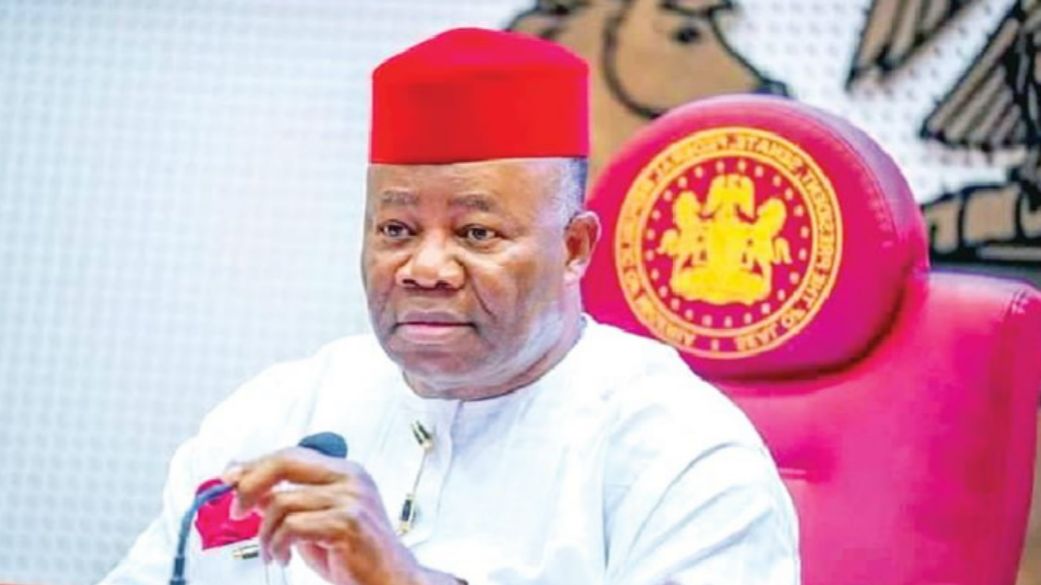
Senate President Godswill Akpabio has defended the recent amendment to the Senate Standing Rules, dismissing criticism from Senator Adams Oshiomhole and insisting the changes were designed to strengthen the institution, not protect personal interests.
Akpabio’s position was contained in a statement issued on Sunday by his spokesman, Eseme Eyiboh, amid growing controversy over the revised Senate rules and calls for his resignation.
The Senate President argued that the amendment introducing experience requirements for senators seeking key presiding and principal offices was necessary to promote competence, stability and institutional continuity within the National Assembly.
According to him, the debate surrounding the amendment had been wrongly focused on personalities instead of the long-term interest of the Senate as an institution.
Akpabio maintained that leading the Senate requires more than political influence or popularity, stressing that the office demands deep knowledge of parliamentary procedures, legislative traditions, constitutional interpretation, committee operations and intergovernmental relations.
He explained that parliamentary leadership is highly technical and sensitive, adding that experience remains essential for effective management of the legislature.
The former Akwa Ibom governor also noted that legislative bodies around the world regularly review and update their rules to improve efficiency and preserve institutional memory.
He argued that such reforms should not automatically be viewed as attempts to sideline new lawmakers or manipulate the political process.
Reacting to claims that the amendment was tailored to protect his position as Senate President, Akpabio insisted that the changes were not designed to reduce competition or advance personal ambition.
He also dismissed arguments that he should resign because the amended requirements would allegedly affect his own eligibility if applied under the new rules.
According to him, laws and parliamentary rules generally take effect from the date they are enacted and cannot be used retroactively to invalidate mandates already secured under previous regulations.
Akpabio said it would be legally and procedurally wrong to apply the new provisions backward to challenge an office legitimately obtained before the amendment.
His response followed recent comments by Senator Adams Oshiomhole, who criticised the amendment and called for Akpabio’s resignation.
The Edo North senator had described the revised rules as evidence of a moral crisis within the Senate, raising concerns about fairness, transparency and leadership ethics.
Oshiomhole also argued that by the standards contained in the proposed amendment, Akpabio no longer met the moral threshold to continue presiding over the upper chamber.
However, Akpabio insisted that public attention should remain on whether the amendment would improve the Senate as a democratic institution rather than on political rivalries or individual grievances.