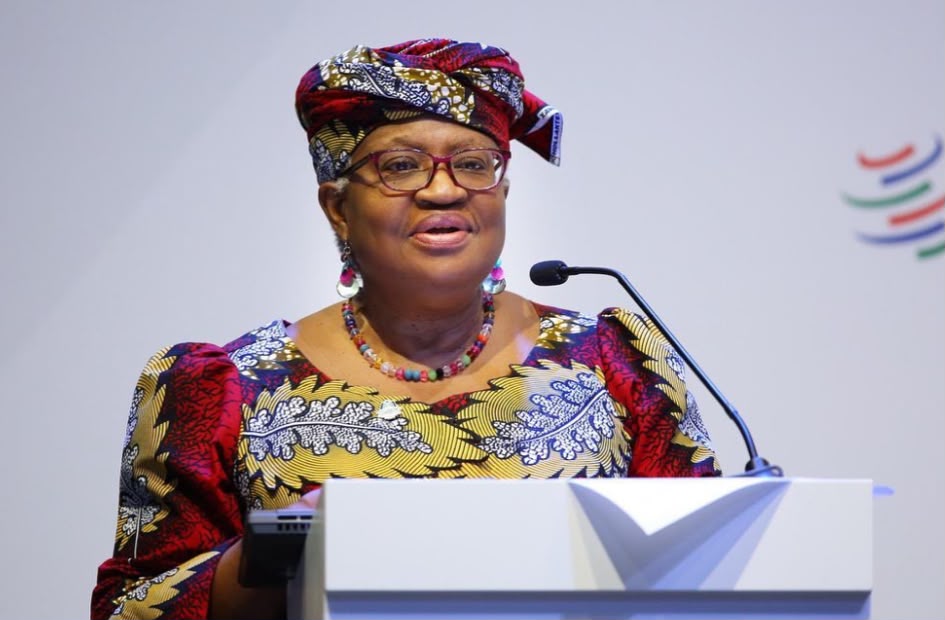
Despite growing trade tensions and policy uncertainties across the world, the Director-General of the World Trade Organization (WTO), Dr. Ngozi Okonjo-Iweala, has revealed that the majority of global trade continues to operate under the organisation’s established rules.
Speaking at the 7th Africa Emerging Markets Forum in Abuja, Okonjo-Iweala said 72% of global goods trade is still conducted under the WTO’s most-favoured-nation (MFN) tariff system, highlighting the continued importance of the global trade body.
The forum was jointly organised by the Central Bank of Nigeria (CBN), Emerging Markets Forum (EMF), and the Centre for the Study of the Economies of Africa (CSEA).
According to her, global trade has remained resilient despite challenges caused by tariff increases and trade policy uncertainty.
“Around 72 per cent of global goods trade continues to flow on core WTO most-favoured-nation tariffs,” she said.
She further explained that an additional 16% of world trade takes place under bilateral and regional trade agreements that are built on the WTO’s framework.
“An additional 16 per cent goes on terms within the wider WTO framework, mostly tariff preferences arising from bilateral and regional trade agreements that are built on WTO foundations,” she added.
Okonjo-Iweala also highlighted the strong performance of global trade in recent years. According to her, world merchandise trade increased by 4.6%, driven largely by rising demand for artificial intelligence (AI)-related products.
She noted that services trade also recorded a 5.3% increase, while digitally delivered services grew by almost 6%, reflecting the rapid expansion of the global digital economy.
Comparing current trade figures with the period before the COVID-19 pandemic, she disclosed that global goods trade volumes in 2025 were more than 12% higher than in 2019, while services trade had grown by 31% over the same period.
Addressing recent global challenges, Okonjo-Iweala said countries affected by the Strait of Hormuz crisis have responded by introducing more trade-facilitating measures rather than imposing restrictions.
“They are lifting trade restrictions, facilitating trade in oil and gas products, and finding alternative routes to get oil and fertiliser out of the region,” she said.
However, she admitted that those efforts have not completely offset the impact of disruptions in the Strait of Hormuz, which have contributed to rising energy, fertiliser, and food prices, particularly in vulnerable African countries.
She also pointed to the growing influence of developing economies in global commerce, noting that South-South trade has expanded significantly over the past three decades.
According to her, the share of trade between developing countries has risen from less than 10% in 1995 to about 25% today, while nearly half of all regional trade agreements notified to the WTO are now between developing nations.
Okonjo-Iweala added that several economies outside the WTO are also working towards joining the organisation, a sign that many countries still see value in a rules-based global trading system.
Source: News Agency of Nigeria (NAN).