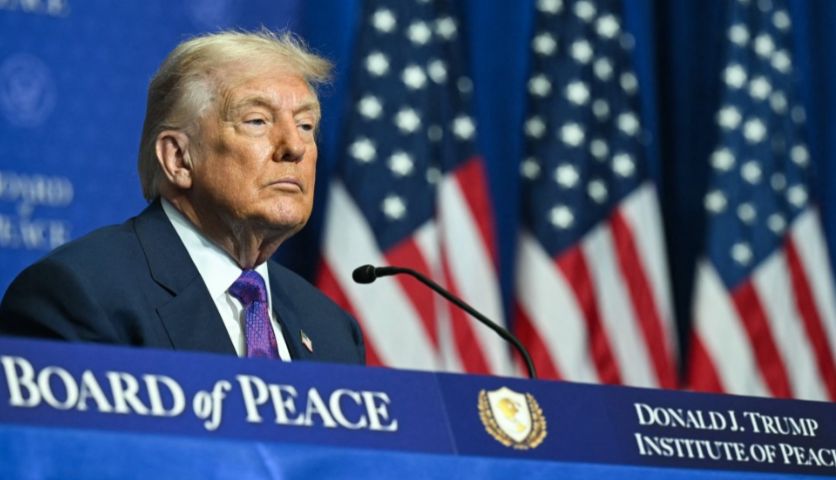
A new report by the Financial Times has claimed that the official fund linked to former US President Donald Trump’s “Board of Peace” currently contains no money, despite several countries reportedly pledging billions of dollars to the initiative.
According to the report, the fund — which was created to support the rebuilding of Gaza after the Israel-Hamas conflict — has allegedly received “zero dollars” in official deposits since it was established in January.
Trump reportedly introduced the Board of Peace as part of efforts to oversee reconstruction projects in Gaza following a US-backed ceasefire agreement reached in October after nearly two years of war.
However, the initiative quickly attracted attention and controversy after invitations were reportedly extended to leaders including Russian President Vladimir Putin and several countries not traditionally involved in Middle East diplomacy.
The Financial Times, citing unnamed sources familiar with the matter, reported that while the fund is officially managed through the World Bank and backed by the United Nations, no donor money has been paid into the official account.
“Zero dollars have been deposited,” one source reportedly told the newspaper.
Instead, donations are said to have been redirected into a separate JPMorgan account connected to the board.
The report also claimed there are currently no independent transparency rules governing the JPMorgan account, raising concerns about oversight and accountability.
Several major European countries reportedly refused to join the initiative, including France and the United Kingdom.
Observers have described the board as being heavily influenced by Trump personally, with reports claiming the former US president retains final authority over its operations even beyond his presidency.
Trump had earlier announced that the United States would contribute $10 billion to the board, while countries such as Qatar, Saudi Arabia, and the United Arab Emirates were also expected to contribute at least $1 billion each.
According to the board’s charter, member countries are reportedly required to contribute $1 billion to secure permanent membership.
Meanwhile, an earlier assessment by the European Union and the United Nations estimated that more than $71 billion may be needed over the next decade to rebuild war-damaged areas of Gaza.
Despite the ceasefire agreement reached in October, violence has reportedly continued in parts of Gaza, with both Israel and Hamas accusing each other of violating the truce.
The report has already generated global reactions online as questions emerge over the management and transparency of the reconstruction initiative.
Source: Financial Times report monitored by AFP.
Report Claims Trump’s ‘Board of Peace’ Fund Has No Money Despite Billion-Dollar Pledges
A new report by the Financial Times has claimed that the official fund linked to former US President Donald Trump’s “Board of Peace” currently contains no money, despite several countries reportedly pledging billions of dollars to the initiative.
According to the report, the fund — which was created to support the rebuilding of Gaza after the Israel-Hamas conflict — has allegedly received “zero dollars” in official deposits since it was established in January.
Trump reportedly introduced the Board of Peace as part of efforts to oversee reconstruction projects in Gaza following a US-backed ceasefire agreement reached in October after nearly two years of war.
However, the initiative quickly attracted attention and controversy after invitations were reportedly extended to leaders including Russian President Vladimir Putin and several countries not traditionally involved in Middle East diplomacy.
The Financial Times, citing unnamed sources familiar with the matter, reported that while the fund is officially managed through the World Bank and backed by the United Nations, no donor money has been paid into the official account.
“Zero dollars have been deposited,” one source reportedly told the newspaper.
Instead, donations are said to have been redirected into a separate JPMorgan account connected to the board.
The report also claimed there are currently no independent transparency rules governing the JPMorgan account, raising concerns about oversight and accountability.
Several major European countries reportedly refused to join the initiative, including France and the United Kingdom.
Observers have described the board as being heavily influenced by Trump personally, with reports claiming the former US president retains final authority over its operations even beyond his presidency.
Trump had earlier announced that the United States would contribute $10 billion to the board, while countries such as Qatar, Saudi Arabia, and the United Arab Emirates were also expected to contribute at least $1 billion each.
According to the board’s charter, member countries are reportedly required to contribute $1 billion to secure permanent membership.
Meanwhile, an earlier assessment by the European Union and the United Nations estimated that more than $71 billion may be needed over the next decade to rebuild war-damaged areas of Gaza.
Despite the ceasefire agreement reached in October, violence has reportedly continued in parts of Gaza, with both Israel and Hamas accusing each other of violating the truce.
The report has already generated global reactions online as questions emerge over the management and transparency of the reconstruction initiative.
Source: Financial Times report monitored by AFP.