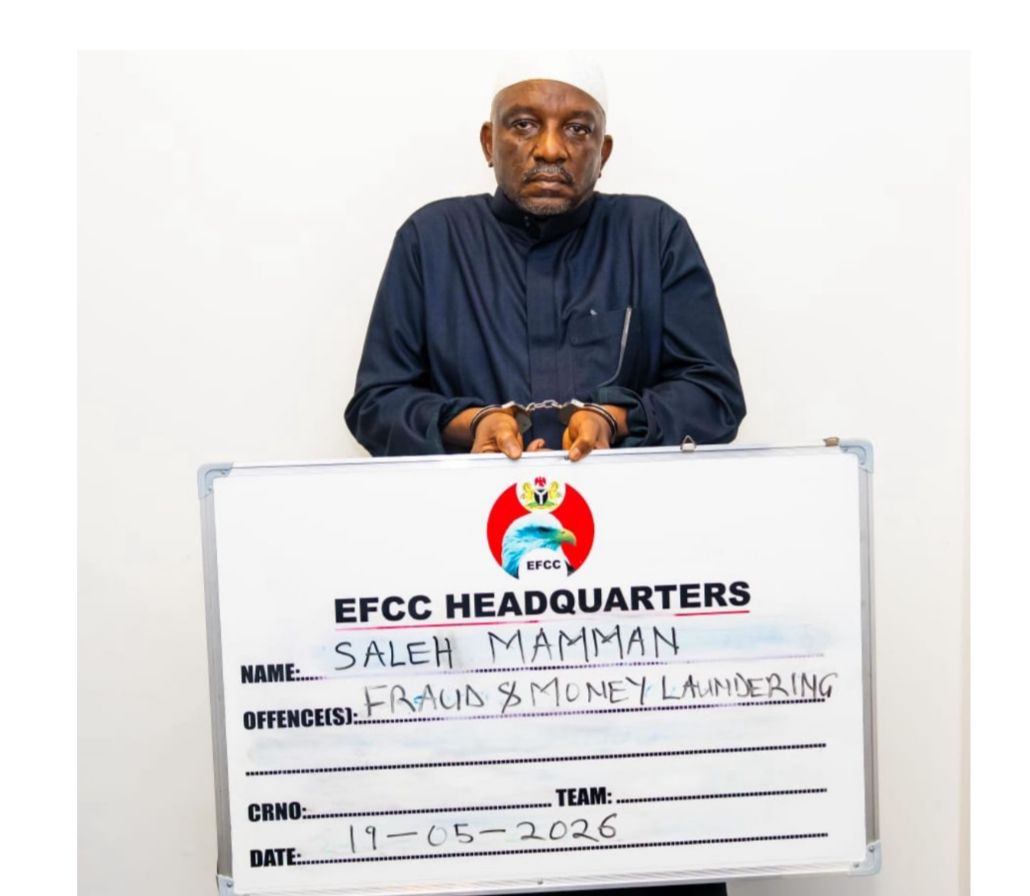
The Economic and Financial Crimes Commission has arrested former Minister of Power, Saleh Mamman, days after he was convicted and sentenced by a Federal High Court in Abuja over alleged corruption involving billions of naira.
EFCC Chairman, Ola Olukoyede, confirmed during a press briefing in Abuja on Tuesday that the former minister was arrested around 3:30 a.m. in Kaduna State.
Mamman was recently sentenced in absentia to 75 years imprisonment after being found guilty on 12 counts bordering on money laundering and fraud linked to the diversion of N33.8 billion meant for the Mambilla and Zungeru hydropower projects.
Olukoyede disclosed that two other individuals allegedly shielding the former minister were also arrested during the operation.
According to him, the property where Mamman was apprehended is currently under investigation by the anti-graft agency.
“I’m happy to announce to Nigerians that at about 3:30 a.m. this morning, we arrested Mr. Saleh Mamman,” Olukoyede said.
The EFCC boss described the arrest as proof of the Federal Government’s determination to fight corruption and ensure accountability in public office.
“This is a test of the commitment of the Federal Government of Nigeria to the fight against corruption in Nigeria and to assure Nigerians that anyone who has dipped into government or national resources will not go unpunished,” he stated.
“The eagle eye of the Economic and Financial Crimes Commission will always catch up with you wherever you are hiding,” Olukoyede added.
He assured Nigerians that the commission would continue investigating both public officials and private individuals accused of corruption.
“We are working. There is no area that we will not go into. We will not leave any area untouched just to ensure that we fulfil our mandate,” he said.
“We will uphold our mandate and ensure that everyone, whether private or public, will be investigated and brought to court.”
Olukoyede explained that the EFCC had filed charges against Mamman as far back as January 2025 over allegations that he diverted over N33 billion allocated for major power projects.
“Even before May 24, sometime in January 2025, we filed a charge against the ex-Minister of Power for allegedly converting over N33 billion that was set aside for Mambilla and Zungeru power projects,” he revealed.
According to him, after nearly 15 months of prosecution, the commission secured convictions on all 12 counts brought against the former minister.
“About 14 to 15 months down the line, specifically on the 7th of this month, we secured a conviction on all 12 counts,” Olukoyede stated.
He explained that sentencing was delayed because the defendant failed to appear in court, leading to judgment being delivered in absentia on May 13.
“Because the main defendant was not present then, the issue of sentencing was shifted, and on the 13th of this month, he was sentenced in absentia,” he said.
Following the conviction, the EFCC launched intelligence and surveillance operations across the country to locate the former minister.
“Since then, we have decided to open our Intelligence, Surveillance and Recovery operations, looking for him all over the place,” Olukoyede disclosed.
Responding to questions about why Mamman remained in EFCC custody instead of a correctional centre, Director of Public Prosecution, Rotimi Oyedepo, said arrangements were ongoing to transfer him in line with the court’s directive.
“The process of transmitting him to the correctional centre is ongoing. The Commission has not just arrested him; it has ensured the sentence is being executed,” Oyedepo stated.
The EFCC also warned that anyone found harbouring or assisting a convicted fugitive would face prosecution.
Olukoyede further revealed that investigators had uncovered additional properties allegedly linked to the former minister and promised that the agency would expand its investigation.
He also hinted at stricter monitoring of high-profile corruption suspects in future cases to prevent them from fleeing during trial.
“Going forward, there is a need for us to also review our processes, particularly as it relates to ongoing court proceedings,” he said.
“Because it is not in the interest of the country for someone who is under criminal trial or prosecution to escape from jurisdiction.”