The World Health Organization has warned that the recent Ebola and hantavirus outbreaks are signs of increasingly dangerous global health challenges facing the world.
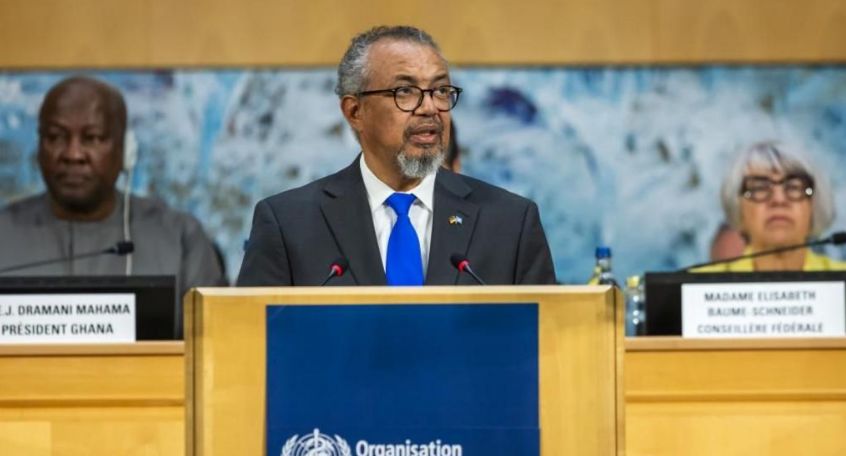
Speaking on Monday during the opening of the World Health Assembly in Geneva, WHO Director-General Tedros Adhanom Ghebreyesus said the outbreaks highlight the growing pressures confronting international health systems.
Tedros referenced the fresh Ebola outbreak in the Democratic Republic of Congo, which the WHO recently classified as an international health emergency, alongside the rare hantavirus outbreak linked to the MV Hondius cruise ship.
According to him, the two health emergencies are part of broader global crises affecting countries worldwide.
The WHO chief said conflicts, economic instability, climate change and cuts in international aid are worsening global vulnerability and creating more difficult conditions for public health responses.
Tedros is expected to provide further details on the risks and global health situation during his main address to the week-long assembly on Tuesday.
Spanish Prime Minister Pedro Sanchez also addressed delegates at the gathering, where he stressed the importance of international cooperation in managing health emergencies.
Spain recently received global praise after allowing the virus-hit MV Hondius cruise ship to dock near the Canary Islands so passengers and crew could be evacuated safely.
Sanchez told world leaders that no country can effectively protect itself in isolation, insisting that global solidarity remains essential during health crises.
He warned against growing selfishness among nations, describing the situation as a “pandemic of egoism” during difficult global times.
The 2026 World Health Assembly comes at a challenging period for the WHO following funding cuts and the United States’ decision to withdraw from the organisation.
Swiss Health Minister Elisabeth Baume-Schneider revealed that the WHO’s budget had been reduced by about 21 per cent, amounting to nearly one billion dollars.
She explained that the funding crisis forced the organisation to cut jobs and scale back several programmes while still responding to global emergencies.
Despite the financial strain, global health experts said the WHO had continued to play a crucial role in coordinating international responses to outbreaks.
Suerie Moon, co-director of the Global Health Centre at the Geneva Graduate Institute, said the hantavirus situation demonstrated why the world still needs a trusted and properly funded global health body.
The assembly also witnessed renewed controversy over Taiwan’s request to regain observer status at the WHO, a position it previously held between 2009 and 2016 before opposition from China.
Other politically sensitive matters expected to generate debate during the meeting include issues involving Ukraine, the Palestinian territories and Iran.
Meanwhile, negotiations over the WHO’s proposed pandemic treaty remain unresolved due to disagreements between wealthy nations and developing countries.
Countries had hoped to finalise important sections of the agreement this year, especially provisions relating to sharing pathogens and distributing vaccines, treatments and testing tools during future pandemics.
However, talks remain stalled, with member states likely to extend negotiations for another year.
Questions also remain over the proposed withdrawal of the United States and Argentina from the WHO.
Former US President Donald Trump initiated the withdrawal process shortly after returning to office in January 2025, while Argentina later followed with a similar move.
The WHO has not officially confirmed either withdrawal because the organisation’s constitution does not contain a formal exit clause.
Reports indicate that the United States still owes the WHO about $260 million in unpaid contributions covering 2024 and 2025.
Diplomats reportedly prefer maintaining uncertainty around Washington’s status rather than forcing a final decision immediately.
The assembly is also expected to discuss broader reforms to the global health system amid concerns that many international organisations overlap in responsibilities and often struggle to coordinate effectively.
Ghanaian President John Dramani Mahama told delegates that the global health system is entering a new phase following the Covid-19 pandemic.
According to him, the world is witnessing the end of one era and must now build a stronger and more effective global health structure for the future.
(AFP)