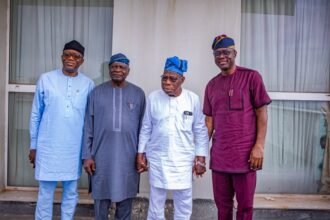
Nigeria’s opposition politics may have entered a decisive new phase after former presidential candidates Peter Obi and Rabiu Musa Kwankwaso formally joined the Nigeria Democratic Congress (NDC), a move that has triggered fresh defections and intensified political calculations ahead of the 2027 presidential election.
Within days of their exit from the crisis-ridden African Democratic Congress (ADC), senators, members of the House of Representatives and several political blocs associated with the former coalition began gravitating toward the NDC.
The speed of the realignment has quickly transformed the relatively young party from a marginal platform into one with growing national visibility, legislative presence and increasing political momentum.
The development has also unsettled both the ruling camp and rival opposition blocs, reopening debate over whether Nigeria’s fragmented opposition may finally be moving toward a stronger coalition capable of mounting a serious challenge to Bola Ahmed Tinubu in 2027.
Why the Obi-Kwankwaso alliance is attracting attention
Much of the growing interest around the alliance is being driven by changing political arithmetic.
In the 2023 presidential election, Obi secured about 6.1 million votes while Kwankwaso polled roughly 1.5 million. Combined, both candidates attracted more than 7.6 million votes, compared with Tinubu’s approximately 8.8 million.
Although both men contested on separate platforms, they built some of the strongest grassroots movements seen in recent political cycles, especially among young urban voters, first-time voters and northern populist blocs.
The emerging alliance is therefore significant not only because of the combined electoral strength of both politicians, but also because of the possibility of bringing together their organisational structures, volunteer networks and growing legislative influence under one political platform.
Unlike the 2023 election, when both men operated independently, the new political arrangement is already attracting sitting lawmakers.
Several senators and House of Representatives members have reportedly moved toward the NDC following the alliance, strengthening the perception that the party could evolve into a serious national force before the next general election.
Among the early defectors is Victor Umeh, who cited instability, prolonged litigation and internal leadership disputes within the ADC as major reasons for his decision.
Umeh explained that recurring internal battles had made it increasingly difficult for serious political actors to focus on broader national issues. According to him, the decision followed consultations with supporters and political associates.
The movement of lawmakers into the NDC has also fuelled speculation that more opposition figures may switch camps in the coming months, especially if the party continues to gain traction across the country.
Some within opposition circles believe the defections reflect growing concern among politicians about entering the 2027 election cycle without a stable platform capable of surviving internal crises and external political pressure.
ADC crisis creates fresh political opening
Only a few months ago, the ADC appeared well positioned to become the main coalition platform for opposition leaders seeking to build a united front against the ruling All Progressives Congress (APC).
That coalition, however, became increasingly unstable following internal disagreements, leadership struggles and fears of prolonged litigation.
The breakdown of trust within the alliance eventually pushed Obi and Kwankwaso toward the NDC, which party leaders now present as a more stable platform with fewer risks of factional breakdown.
Obi explained that the decision to leave the ADC was driven by the need to avoid endless internal conflict and focus instead on issues affecting ordinary Nigerians.
According to him, the new political move is part of a broader effort to help build a united, secure and prosperous Nigeria that works for all citizens.
He also warned against the growing culture of political litigation, arguing that repeated internal court battles have consistently weakened opposition movements before elections.
His remarks have strengthened growing concerns within opposition circles that legal disputes and internal fragmentation have remained some of the biggest obstacles to building a competitive national alternative.
Kwankwaso also presented the move as part of a wider effort to rebuild democratic opposition politics.
He said the decision to join the NDC was based on democratic principles and the need to provide Nigerians with a credible political alternative ahead of the next election cycle.
NDC positions itself as emerging opposition platform
Senior figures within the NDC have openly embraced the growing perception that the party is becoming a new centre of opposition politics.
Former Henry Seriake Dickson, now a leading figure within the party, recently described the NDC as stable, united and largely free from the factional crises affecting rival opposition platforms.
Party officials have also intensified efforts to attract defectors from the ADC, Labour Party, New Nigeria Peoples Party and disenchanted factions within the Peoples Democratic Party.
According to party leaders, opposition forces can only become truly competitive in 2027 through broad cooperation and strategic consolidation.
The rapid rise of the NDC has already unsettled parts of the opposition landscape.
Within the ADC, some loyalists believe the departure of Obi and Kwankwaso could weaken ongoing coalition efforts. Others argue that the defections may ultimately trigger a wider realignment among opposition figures who are unwilling to enter another presidential election divided and weakened.
Political observers say the development has already generated intense political calculations in Abuja, with many politicians now weighing whether the NDC could emerge as the principal opposition platform heading into 2027.
APC dismisses growing momentum
Despite the growing attention, the ruling APC has dismissed the political excitement surrounding the NDC.
APC National Publicity Secretary Felix Morka criticised Obi’s movement across multiple political parties, arguing that it reflects political inconsistency rather than strategic strength.
According to him, the opposition remains fragmented and largely driven by personalities rather than clear ideological direction.
Privately, however, some ruling party figures are said to be closely monitoring developments, especially because of the alliance’s appeal among younger voters and politically dissatisfied urban communities.
Even among those dismissing the NDC’s rise, there is recognition that the coming months will test whether the party can convert current enthusiasm into durable nationwide structures.
One of the biggest challenges before the NDC will be whether it can sustain momentum beyond the early excitement generated by the Obi-Kwankwaso alliance.
The party will also have to navigate issues such as zoning, party ticket negotiations, leadership control at state and ward levels, and the management of competing political interests.
Concerns over electoral credibility remain
Beyond the current wave of defections and alliances, questions over the credibility of the 2027 election are also beginning to dominate political discussion.
Some opposition figures argue that even a united coalition may struggle if electoral institutions fail to guarantee a level playing field.
Those concerns have intensified amid continuing debates over insecurity, judicial intervention in political disputes and the broader influence of incumbency in Nigerian elections.
Joash Ojo Amupitan of the Independent National Electoral Commission acknowledged the security challenges facing the electoral process while maintaining that the commission remains committed to delivering free, fair, credible and inclusive elections in 2027.
However, his assurances have not completely eased scepticism within opposition circles, where many still question whether Nigeria’s institutions can guarantee a genuinely transparent and competitive electoral contest.
A changing political conversation
For now, the rapid rise of the NDC has already altered the political conversation in Abuja.
What only weeks ago appeared to be another fractured opposition landscape after the recent opposition summit in Ibadan is increasingly being viewed as a possible point of consolidation ahead of the 2027 presidential election.
Whether the Obi-Kwankwaso alliance ultimately becomes a durable political force remains uncertain.
But one thing is already clear: the emergence of the NDC has redrawn opposition battle lines and injected fresh energy into Nigeria’s race toward 2027.