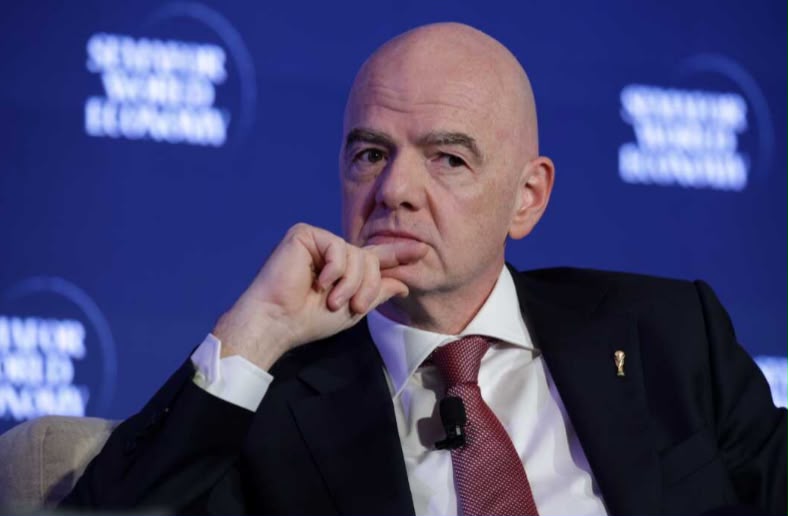
FIFA President Gianni Infantino is facing renewed criticism after UEFA, CONCACAF and the Asian Football Confederation (AFC) jointly warned that football does not belong to any individual and called for greater accountability in the sport’s global leadership.
The three football confederations issued the strong-worded message on Monday, days after FIFA abandoned a controversial proposal to bring private investment into its competitions, including the World Cup.
The investment plan had attracted strong opposition from several football authorities, with UEFA particularly critical of the proposal. FIFA had subsequently accused some individuals of mounting a coordinated campaign to undermine the organisation and its president.
However, the latest statement from UEFA, CONCACAF and AFC shows that opposition to Infantino remains strong.
“Leadership in football is not a possession. It is not about holding — or demanding — power to be held,” the confederations said.
They added:
“When trust is broken through deception, when an individual places himself above the collective that entrusted him with authority, that duty has been abandoned.”
Infantino Faces Growing Opposition
The dispute could have major implications for Infantino’s bid for a fourth and final term as FIFA president. The election is scheduled to take place in Rabat next March, while potential candidates must declare their intention to contest by November 18.
CONCACAF President Victor Montagliani is viewed as a possible challenger to Infantino.
UEFA had previously threatened to boycott the World Cup if the private investment proposal went ahead. Such a move could potentially have affected major football nations, including reigning world champions Spain, as well as France and England.
The threat was considered a major factor in Infantino’s decision to withdraw the proposal.
Before the controversy, Infantino appeared likely to face little opposition after overseeing the expanded World Cup in the United States, Mexico and Canada.
The 56-year-old Swiss has led FIFA for about a decade and has received backing from the Confederation of African Football (CAF), while South America’s governing body, CONMEBOL, has generally been supportive.
However, FIFA’s confederations do not vote as unified blocs, meaning support for Infantino varies among individual members.
Confederations Demand Accountability
The three confederations also rejected FIFA’s explanation that the controversy surrounding the investment proposal was mainly a communication failure.
“It treats this as a failure of communication, when what football witnessed was a failure of judgment,” they said.
They also criticised an emergency meeting Infantino held in Morocco, where FIFA said senior directors had expressed their full support for him.
According to the confederations, the meeting involved only selected members of the FIFA Management Committee rather than the full committee, and they questioned why FIFA’s leadership did not instead address staff at the organisation’s headquarters in Zurich.
“It is not the conduct of a custodian of the game, but of one who believes the game is answerable to him,” they said.
‘Football’s Growth Was Never One Man’s Work’
The confederations also pushed back against the perception that Infantino alone was responsible for FIFA’s growth over the past decade.
They acknowledged that football had experienced significant expansion under his leadership but insisted that the progress was achieved collectively.
“But that progress was never the work of one individual,” they said.
According to UEFA, CONCACAF and AFC, the expansion of FIFA competitions, the awarding of the 2030 and 2034 World Cups and the distribution of resources to national associations were all collective achievements involving FIFA, the confederations, member associations and thousands of people working across the sport.
The confederations concluded their letter by accusing FIFA’s leadership of failing to provide sufficient openness and accountability.
“Football’s strength has always been its unity,” they said, insisting that their position was taken collectively and in what they described as a duty to protect the game.
The latest confrontation leaves Infantino facing a potentially more challenging path toward securing another term as FIFA president, with the debate over leadership, transparency and control of the world’s most popular sport becoming increasingly prominent.
Source: AFP.