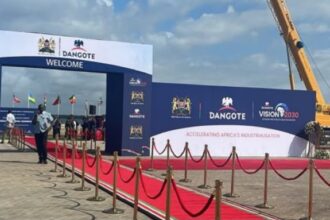
Africa’s richest man, Aliko Dangote, has officially begun the construction of a $16 billion mega-refinery in Kenya, describing the project as a major step in Africa’s industrial development.
The refinery is being developed in Lamu, on Kenya’s Indian Ocean coast, and is expected to have a refining capacity of 700,000 barrels per day.
If completed as planned, the facility would have a larger capacity than any refinery currently operating in Europe.
Construction is expected to take between 30 and 40 months.
Dangote, who operates Africa’s largest oil refinery in Nigeria, said the Kenyan project would contribute to the continent’s efforts to process more of its own resources and reduce dependence on imported refined petroleum products.
“This is Africa coming together to build Africa. Today we are not simply breaking ground for a refinery, we’re breaking ground for a new chapter in Africa’s industrial journey,” Dangote said.
Kenyan President William Ruto joined Dangote at the groundbreaking ceremony alongside other regional leaders, including Ethiopian Prime Minister Abiy Ahmed and Ugandan President Yoweri Museveni.
Ruto described Lamu as a strategic location for Kenya’s future economic development and assured residents that concerns surrounding the project would be addressed through the appropriate legal processes.
“Lamu will be the epicentre of the development of our country,” Ruto said.
Land, Environmental Concerns
The refinery project has faced opposition from a local community over land rights.
A court ruling issued on Monday cleared the way for the groundbreaking ceremony to proceed, although the legal dispute itself remains ongoing.
Environmental groups, including Greenpeace, have also raised concerns about the potential impact of the project on Lamu.
The area is a major tourist destination and home to one of the oldest Swahili settlements, dating back to the 12th century. Lamu is also recognised as a UNESCO World Heritage site.
Dangote said he was not deterred by the legal challenges surrounding the project.
“We’re not really scared of people taking us to court. Anybody who wants to cause trouble, we are ready for his trouble and will give him a headache,” he said.
Ruto, meanwhile, said land and environmental concerns would be handled “lawfully and fairly.”
Regional Competition Emerges
The refinery is also being developed amid increasing competition for major energy investments in East Africa.
Uganda and Tanzania announced plans in August for a $20 billion refinery and energy hub at the Tanzanian port of Tanga, although details of the proposed project remain limited.
Uganda is also preparing to begin its first oil production and has nearly completed a pipeline designed to transport crude to the Tanzanian coast.
This means much of the crude required by Dangote’s Kenyan refinery is likely to initially come from outside the region.
Dangote said the refinery would source crude from the Middle East, the United States and other producing regions, while remaining prepared to process more African crude as countries such as Kenya and Mozambique increase production.
The businessman said he had previously considered Tanzania as the location for the refinery but ultimately selected Lamu because of its deep-sea port and what he described as its solid land.
The project will also include a 1,000-megawatt power facility, with half of the electricity expected to be supplied to Kenya’s national grid.
Dangote Targets Greater Value Creation in Africa
Dangote presented the refinery as part of a wider effort to ensure African countries capture more value from their natural resources instead of exporting raw materials and importing finished products.
“For too long, our continent has actually been rich in resources but poor in value creation and addition. We have exported crude oil and imported refined products,” he said.
He argued that the pattern has resulted in African countries losing jobs and economic opportunities that could otherwise be created locally.
“Such practice only leads to us exporting our jobs and opportunities that should remain on the continent and lead us into importing poverty into our nations. Africa cannot build lasting prosperity by exporting what it has and importing what it needs,” Dangote added.
Ruto cited data showing that Africa produced about 6.8 million barrels of crude oil per day in 2024 while consuming approximately 4.5 million barrels per day of refined petroleum products.
He said the figures highlight the continent’s significant demand for refined fuel and the economic value that is still being captured by refineries outside Africa.
Source: AFP.