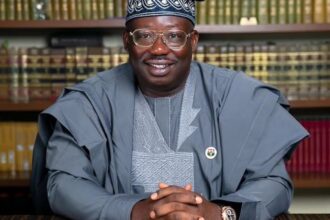
The Minister of Finance and Coordinating Minister of the Economy, Prof. Taiwo Oyedele, has defended the Federal Government’s borrowing policy, insisting that debt should be seen as a strategic tool for economic growth rather than something inherently negative.
Speaking at the 2026 Annual Conference of the Capital Market Academics of Nigeria (CMAN) in Abuja, Oyedele said public debates about government borrowing often focus on the wrong issue.
According to him, what matters is not how much a country borrows, but how the borrowed funds are used and whether they generate returns that outweigh the cost of the debt.
“In much of our public discourse, debt is spoken of as a moral failing rather than a financial instrument,” Oyedele said.
“The relevant question is never simply how much debt. It is always debt for what, at what cost, against what return, and repaid on what terms.”
The minister argued that governments, businesses and individuals should not shy away from borrowing if the funds will be invested in productive ventures capable of driving economic growth.
“When analysts go on television and join the populist view to accuse the government of borrowing, you are doing a disservice,” he added.
Oyedele also criticised the reluctance of many Nigerian entrepreneurs to bring in external investors, saying the desire to retain full ownership often limits business expansion.
“The desire to own 100 per cent of a small business will always lose in absolute terms to owning a meaningful share of a large one,” he said.
To improve Nigeria’s business environment, the finance minister proposed the establishment of a Commercial Dispute Resolution Tribunal to speed up the resolution of commercial cases.
He noted that business disputes currently spend years in the regular court system, discouraging investment and slowing economic activities.
According to him, the proposed tribunal should consist of judges and arbitrators with expertise in commercial and financial matters, supported by digital case management systems and strict timelines.
Oyedele also stressed the need for stronger institutions, policy consistency and greater investor confidence to attract more domestic and foreign investment into Nigeria.
Earlier, the Director-General of the Securities and Exchange Commission (SEC), Dr. Emomotimi Agama, called for closer collaboration between regulators and academics to promote evidence-based policymaking.
The President of the Capital Market Academics of Nigeria (CMAN), Prof. Uche Uwaleke, also urged stronger partnerships between universities and the financial industry to deepen Nigeria’s capital market and support economic development.