
Kenneth Okonkwo, a chieftain of the African Democratic Congress (ADC), has questioned Peter Obi’s ability to lead Nigeria, arguing that the former Labour Party presidential candidate lacks the capacity and temperament required to confront the country’s complex challenges.
Okonkwo made the remarks during an interview on Arise Television on Wednesday, shortly after Obi announced his exit from the ADC.
During the interview, Okonkwo dismissed suggestions that Obi’s departure would create any major setback for the ADC, insisting that the party would continue to move forward without him.
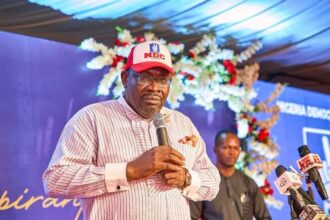
Peter Obi, the Labour Party’s presidential candidate in the 2023 general election, formally left the ADC on Sunday and joined the Nigeria Democratic Congress (NDC). He moved alongside former Kano State governor Rabiu Musa Kwankwaso.
Obi explained that his decision was influenced by internal disagreements, prolonged legal disputes, and what he described as persistent internal battles within the ADC.
However, Okonkwo said the coalition would not be shaken by Obi’s exit. He pointed to Obi’s recent political movements, arguing that his frequent party changes have become a defining feature of his political career.
According to him, Obi was still a member of the Labour Party on December 30, moved to the ADC on December 31, and by May 3 had joined the NDC.
Okonkwo said the pace of those changes raises serious questions about consistency, political stability, and commitment.
WHAT HE SAID
Speaking during the interview, Okonkwo suggested that if not for the legal restrictions contained in the Electoral Act, Obi might have moved again.
He said Obi’s repeated movement across political parties reflects a broader pattern in his political style.
Okonkwo also questioned Obi’s readiness to tackle the difficult realities facing Nigeria.
According to him, a leader who appears to withdraw from internal political struggles may not be well-positioned to confront the deeper national problems of governance, insecurity, economic hardship, and institutional instability.
He argued that Obi’s temperament and political approach do not match the kind of leadership Nigeria currently requires.
In his words, the ADC therefore has little reason to feel the impact of Obi’s departure.
Okonkwo maintained that Obi’s political relevance had already weakened before he joined the ADC.
He claimed that before entering the party, Obi had already begun losing political ground, citing his inability to maintain influence even within his home state of Anambra.
According to him, Obi had struggled politically in his own base and was no longer commanding the level of influence he once enjoyed.
He further alleged that Obi did not join the ADC through Anambra State but instead entered through Enugu State.
Okonkwo argued that rather than strengthening the ADC, the party actually provided Obi with a political lifeline at a difficult moment in his career.
He said the party was already making progress before Obi arrived and did not depend on him for direction, relevance, or growth.
The ADC chieftain also accused Obi of consistently avoiding competitive party primaries throughout his political journey.
He claimed that Obi has shown strong reluctance toward internal party contests and argued that this reflects a wider discomfort with political competition.
Okonkwo recalled Obi’s early political experience in the All Progressives Grand Alliance (APGA), alleging that he once lost a primary election but later benefited from internal party intervention that eventually gave him the governorship ticket.
According to him, that episode demonstrated a long-standing pattern of avoiding direct internal electoral battles.
He added that he had predicted Obi’s eventual departure from the ADC from the very beginning, saying the development did not come as a surprise.
Peter Obi’s departure from the ADC comes amid ongoing political realignments ahead of future elections.
In recent months, several politicians have been repositioning, forming new alliances, and moving across party platforms as political calculations intensify.
Obi and Kwankwaso both cited internal disputes and legal uncertainty within the ADC as major reasons for their decision to leave.
The move has further widened conversations around coalition politics, party stability, and the search for viable political platforms ahead of the next electoral cycle.
Kenneth Okonkwo’s remarks have added fresh intensity to the debate over leadership capacity, political loyalty, and readiness for national office.
As political alignments continue to shift, questions about consistency, internal party democracy, and the ability of political figures to confront Nigeria’s challenges are expected to remain central to public discourse in the months ahead.