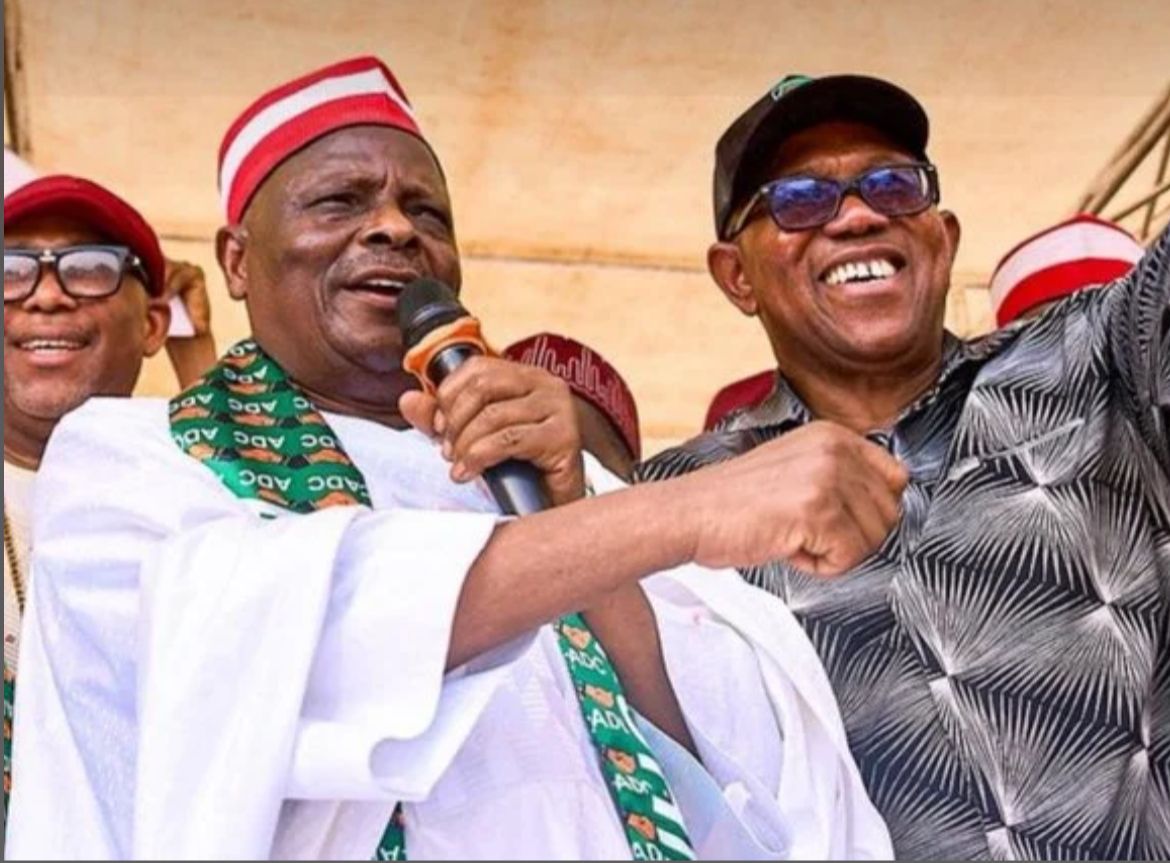
Nigeria’s opposition politics took another dramatic turn on Sunday after former Anambra State Governor, Peter Obi, and former Kano State Governor, Senator Rabiu Musa Kwankwaso, formally left the African Democratic Congress (ADC) and joined the National Democratic Coalition (NDC), a development already reshaping conversations ahead of the 2027 general elections.
The move signals a fresh round of political realignments as opposition leaders continue efforts to build a formidable platform capable of challenging the ruling All Progressives Congress (APC) in the next presidential contest.
Obi, Kwankwaso Officially Join NDC
Political attention intensified after a video circulated online showing both leaders receiving their NDC membership cards. In the footage, Kwankwaso was presented with his membership card first, followed shortly by Obi, confirming their formal entry into the party.
The ceremony came only hours after the two politicians held a closed-door meeting with NDC leaders at the Abuja residence of the party’s National Leader and former Bayelsa State Governor, Senator Seriake Dickson.
The development has since generated widespread reactions across political circles, with analysts describing it as one of the most significant opposition movements in recent months.
Obi Urges Party Members to Avoid Litigation
Shortly after joining the NDC, Peter Obi appealed to members of the party to avoid internal disputes and court battles, warning that legal conflicts have historically weakened political organisations in Nigeria.
In remarks captured in a video that surfaced on Sunday, Obi stressed that unity, discipline, and internal cohesion would be crucial if the party hopes to build a credible alternative ahead of 2027.
“Please let there be no litigation. Party members, please don’t go to court. We want to build a party; we are not lawyers,” he said.
According to him, internal legal battles often distract parties from their broader political objectives and create divisions that ultimately weaken their electoral strength.
Why Obi Left the ADC
Obi later explained the reasons behind his departure from the ADC in a statement shared on X.
He described the internal atmosphere within the party as increasingly unhealthy and linked the development to broader structural problems in Nigeria’s political environment.
According to him, the current political climate has become deeply toxic, with institutions that should protect citizens and create opportunities increasingly failing to serve the public interest.
Obi, however, dismissed claims that his resignation was driven by personal grievances or hostility toward party leaders. He clarified that his decision was not targeted at prominent figures within the ADC, including former Vice President Atiku Abubakar and Senator David Mark.
Kwankwaso’s Camp Confirms Coordinated Exit
Kwankwaso’s camp also confirmed that the move to the NDC was not a spontaneous decision but the outcome of broad consultations involving stakeholders and supporters across various levels.
His spokesperson, Saleh Muhammad, said extensive discussions were held with grassroots political actors before the final decision was reached.
According to him, there was broad agreement that leaving the ADC had become necessary in light of current political realities and preparations for the 2027 elections.
The Presidency reacted sharply to Obi’s defection, with presidential spokesperson Bayo Onanuga criticising the former Labour Party presidential candidate.
In a post on X, Onanuga described Obi as a “political nomad,” arguing that his reasons for leaving the ADC lacked substance. He also accused Obi of repeatedly seeking political routes that avoid direct internal contest.
Onanuga said Obi’s approach reflected a pattern that could ultimately work against his political ambitions, while also welcoming him into what he described as the unfolding 2027 race.
The ruling APC also mocked the development, describing Obi as a “rolling stone” and suggesting that repeated political movement reflects an attempt to secure an uncontested presidential ticket.
Concern Within the ADC Over Coalition Stability
Within the ADC, the departure of the two political heavyweights has raised concerns over the future of ongoing coalition-building efforts among opposition parties.
A senior party figure, Salihu Lukman, addressed Kwankwaso in an open letter titled You Can’t Run Away From Yourself, warning that repeated defections could weaken his political standing and create the impression that personal ambition is taking priority over collective national interest.
Lukman stressed that opposition unity remains one of the most important conditions for defeating the APC in 2027.
He argued that disunity and fragmentation played a major role in the opposition’s inability to secure victory in the 2023 general elections.
According to him, consultations among major opposition leaders—including Peter Obi and Atiku Abubakar—have been ongoing since 2024 with the aim of building a united political front.
He maintained that abandoning those efforts at this stage could undermine the broader objective of presenting a credible alternative to Nigerians.
NDC Welcomes New Entrants
Welcoming the new members, NDC founder and National Leader, Senator Seriake Dickson, described the party as an emerging political force ready to challenge the status quo.
He said the NDC is growing rapidly and remains attractive because it has maintained internal stability.
According to Dickson, the party has no factional crisis and no ongoing litigation, qualities he believes will help it provide a stable platform for political actors seeking national renewal.
He added that the NDC is prepared to compete beyond expectations and position itself as a serious player in the 2027 political landscape.
Support Group Warns Against Further Defections
Meanwhile, the Grassroots Mobilisation Network (GMN), a support group within the ADC, warned that continuous defections could damage the credibility of opposition politics.
National Secretary of the group, Usman Bala Idris, cautioned that repeated movement from one party to another may create public suspicion and raise questions about hidden alignments with the ruling party.
He argued that abandoning party structures at a critical moment would not solve the underlying problems facing the opposition.
According to him, the more constructive approach would be to remain within party structures and work toward rebuilding them from within.
CISLAC Raises Concerns Over Ideology-Free Politics
The Civil Society Legislative Advocacy Centre (CISLAC) also weighed in on the development, warning that Nigeria’s democracy could suffer further erosion if political realignments continue without clear ideological direction.
In a statement issued in Abuja, Executive Director of CISLAC and Head of Transparency International Nigeria, Auwal Ibrahim Musa-Rafsanjani, acknowledged that political defections are a legitimate part of democratic practice.
However, he argued that such movements must be guided by policy ideas, national interest, and clearly defined programmes—not political convenience.
CISLAC noted that frequent defections in Nigeria often lack policy substance, weakening party institutions and reducing public confidence in democratic governance.
The organisation stressed that political parties should represent coherent visions for national development and that any movement across party lines should be tied to practical proposals addressing key national issues such as economic hardship, insecurity, corruption, and social inequality.
While recognising the constitutional right to freedom of association, CISLAC urged Obi and Kwankwaso to clearly explain the purpose of their new political alignment and demonstrate how it would deliver meaningful benefits for Nigerians.
According to the organisation, Nigerians deserve clarity, accountability, and consistency from those who seek public office.
Call for Stronger Democratic Institutions
CISLAC further called on political parties to strengthen internal democracy, improve transparency in candidate selection processes, and avoid actions capable of deepening political fragmentation or voter apathy.
The organisation warned that elite-driven political movements without meaningful citizen engagement could further alienate voters from the democratic process.
It also urged the Independent National Electoral Commission (INEC) to closely monitor all procedures relating to political defections to ensure full compliance with constitutional provisions and electoral guidelines.
According to CISLAC, protecting the integrity of Nigeria’s electoral system remains essential as the country moves closer to another major election cycle.
What This Means for 2027
The entry of Peter Obi and Rabiu Musa Kwankwaso into the NDC has added fresh momentum to Nigeria’s evolving opposition politics.
While supporters see the move as part of a wider effort to create a stronger coalition ahead of 2027, critics argue that frequent political migration without a clearly defined ideological foundation may weaken public confidence.
For now, one thing is clear: the race toward 2027 has entered a new phase, and the political permutations are only beginning.