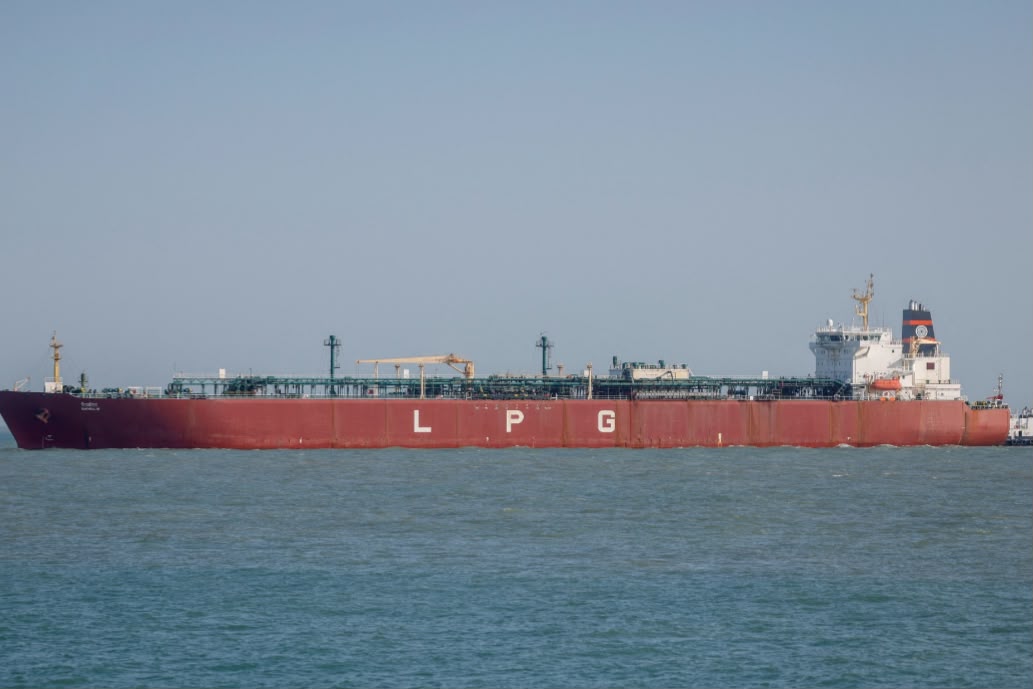
Iran has continued exporting limited quantities of liquefied petroleum gas (LPG) and jet fuel despite a US naval blockade targeting its energy shipments, according to shipping intelligence and maritime security sources.
The shipments, which have reportedly moved through the region since July, offer evidence that some Iranian petroleum products are still reaching international markets despite Washington’s efforts to cut off the country’s oil revenue.
Four maritime security sources told Reuters that Iran has recently concealed some of its cargoes among an increasing number of ship-to-ship transfers conducted by other Gulf producers off the coast of Oman.
Analysis by United Against Nuclear Iran (UANI), a US-based organisation that monitors Iranian tanker movements using shipping and satellite data, identified at least eight gas tankers carrying Iranian LPG that departed the Gulf of Oman from mid-July.
Separately, satellite imagery and analysis by maritime intelligence firm SynMax indicated that another tanker carrying Iranian jet fuel reached Myanmar in September.
The development is significant because the US has imposed sanctions on Myanmar’s jet-fuel industry over concerns about military airstrikes against civilians. Myanmar’s military government has repeatedly denied deliberately targeting civilians, maintaining that its operations are directed against armed groups.
A Reuters review of US Treasury sanctions records found that six of the eight LPG tankers, along with the vessel carrying jet fuel, were under American sanctions for transporting Iranian petroleum and petrochemical products.
Jemima Shelley, a senior research analyst at UANI, said only a small number of tankers carrying Iranian LPG appeared to have passed through the restrictions, while most vessels carrying Iranian products had been redirected by US forces.
She estimated that the LPG shipments amounted to approximately 4.1 million barrels.
According to Shelley, some tankers transferred their cargoes near the Omani coastal towns of Shinas and Sohar, while others waited in the Gulf of Oman before proceeding past the area where US forces said the blockade was operating.
Most of the cargoes reportedly travelled to Malaysia’s Eastern Outer Port Limits, where further ship-to-ship transfers took place, with China considered a likely destination for some of the shipments.
Shelley suggested that the movements reflected opportunistic attempts to move limited quantities of petroleum products rather than evidence of a major new strategy by Iran to resume exports using smaller vessels.
Neither the Iranian government nor Myanmar’s military-backed government responded to requests for comment on the reported shipments.
US Military Defends Blockade
The US military’s Central Command (CENTCOM) has maintained that its naval blockade remains firmly enforced.
The restrictions were initially introduced on April 13 to target Iran-related oil exports. They were lifted in June after Washington reached a draft understanding with Tehran but were reinstated on July 14 following the collapse of the agreement.
A US military official told Reuters that the movement of a vessel through the region does not automatically mean it has evaded the blockade.
According to the official, each ship is assessed individually, including through checks of its documentation. Some vessels may also be permitted to pass for humanitarian reasons.
The official added that appearing on a US sanctions list does not automatically determine whether a vessel is subject to the blockade, noting that operational considerations also influence how American forces monitor and respond to shipping movements.
In an October 13 update, CENTCOM said US forces had disabled four commercial vessels and turned back 135 ships during the preceding three months of the latest blockade.
Previous military statements have also reported vessels being turned around and some tankers seized.
Washington has combined the naval restrictions with financial sanctions intended to cut off Iran’s remaining sources of revenue. Last week, the US Treasury imposed fresh sanctions on 17 vessels accused of transporting Iranian crude oil, petrochemicals and petroleum products.
However, a Treasury spokesperson questioned the reliability of shipping data suggesting that vessels had passed through the blockade, warning that ships could manipulate their reported locations or use false identities during loading.
The spokesperson said such information “should be taken with a grain of salt” and described the combined pressure from the blockade and US economic measures as “suffocating the Iranian regime”.
Iran Faces Growing Pressure on Oil Exports
Despite the reported movement of some petroleum products, Iran’s crude oil exports have faced a much more severe disruption.
Data from energy analytics firm Kpler showed that Iranian crude exports fell to zero in September, marking the first month without a recorded shipment since the company began tracking the country’s exports in 2013.
US Treasury Secretary Scott Bessent has also said the blockade had prevented most Chinese purchases of Iranian oil and left Tehran unable to deliver crude to its customers.
Torbjorn Soltvedt, principal Middle East analyst at risk intelligence company Verisk Maplecroft, warned that worsening economic conditions could encourage Iran to take greater risks to move petroleum products through the restrictions.
He noted that jet fuel could be particularly attractive because US sanctions have placed increasing pressure on Iran’s aviation industry, leaving more aircraft grounded and potentially creating surplus fuel at domestic refineries.
The reported shipments suggest that while the US blockade has severely disrupted Iran’s energy exports, some petroleum products may still be reaching overseas buyers through complicated shipping arrangements.
However, the extent of these movements remains disputed, with US officials questioning the available shipping data and maintaining that the restrictions continue to prevent most Iranian oil exports.