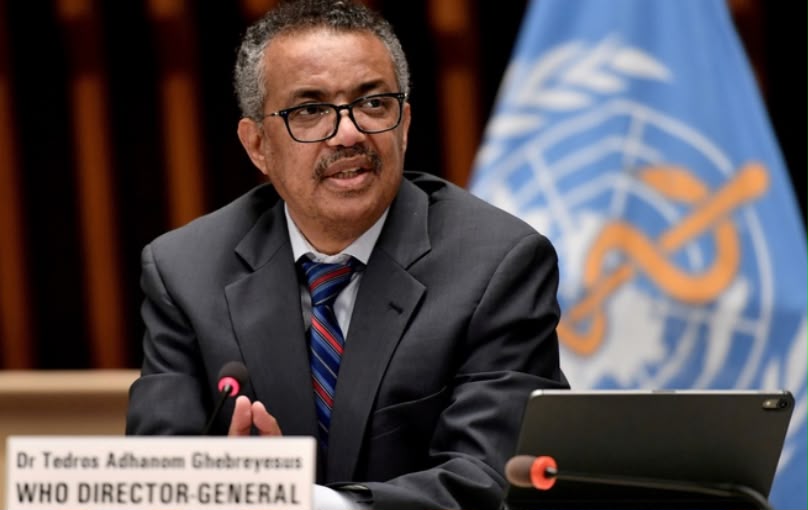
The world must prepare for another major pandemic because a future global health emergency is inevitable, World Health Organisation (WHO) Director-General Dr Tedros Adhanom Ghebreyesus has warned.
Speaking during an online news conference on Friday, Tedros said the COVID-19 pandemic exposed serious weaknesses in global health systems and showed how quickly infectious diseases can become international threats.
The COVID-19 crisis was the most severe global health emergency in a century, with at least 20 million deaths and more than $10 trillion wiped from the global economy.
According to the WHO chief, the lessons from COVID-19 must not be forgotten, particularly because another pandemic will eventually emerge.
“The next pandemic is not a question of if, but when,” Tedros said.
He pointed to the ongoing Bundibugyo Ebola outbreak in the Democratic Republic of the Congo as an example of how an outbreak that begins in one location can quickly become a concern for neighbouring countries and the wider international community.
He also referenced a recent hantavirus outbreak aboard the MV Hondius, saying the incident demonstrated the importance of countries working together when dealing with infectious disease threats.
Tedros said cooperation between countries and international partners, including Spain, played an important role in containing the hantavirus outbreak.
Since the COVID-19 pandemic, WHO has introduced 12 major initiatives aimed at strengthening global health security across six key areas.
Among them is the Pandemic Fund, established with the World Bank to support countries in improving their preparedness for future health emergencies. The Universal Health and Preparedness Review was also created to help strengthen national preparedness systems.
WHO has further established its Hub for Pandemic and Epidemic Intelligence in Berlin to improve disease surveillance, data analysis and early warning systems.
Efforts have also been made to improve access to vaccines and other medical tools, including through COVAX, the mRNA Technology Transfer Programme and the Biomanufacturing Workforce Training Initiative.
Tedros said the WHO BioHub in Switzerland was established to facilitate the international sharing of pathogen samples and support global preparedness.
The Global Health Emergency Corps is another initiative designed to strengthen countries’ ability to respond rapidly and effectively when health emergencies occur.
He also highlighted progress made by member states in strengthening the international rules governing pandemic preparedness.
Countries adopted amendments to the International Health Regulations in 2024, while the WHO Pandemic Agreement was adopted in 2025.
Tedros described the agreement as a major step towards improving international preparedness for future pandemics.
However, negotiations are still ongoing over the Pathogen Access and Benefit Sharing system, which remains the final component needed to complete the framework.
The WHO chief expressed confidence that countries would resolve their remaining differences and reach an agreement, which would allow nations to begin ratifying the Pandemic Agreement and pave the way for its implementation.
Tedros also pushed back against claims that the Pandemic Agreement would give WHO control over national governments.
He described such claims as misinformation, stressing that the agreement was negotiated and adopted by sovereign countries acting in their own interests.
According to him, the global nature of pandemics means countries cannot effectively protect themselves by acting alone.
He said the same principle applies to the political declaration being considered at a United Nations high-level meeting, which contains commitments aimed at closing existing gaps in pandemic prevention, preparedness and response.
Tedros thanked WHO member states for their cooperation and commended Armenia and Rwanda, which are co-chairing the negotiations on the political declaration.
He said WHO would support countries in implementing the commitments made as the international community continues preparing for future health emergencies.
Source: NAN.