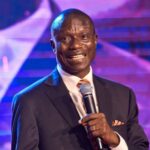
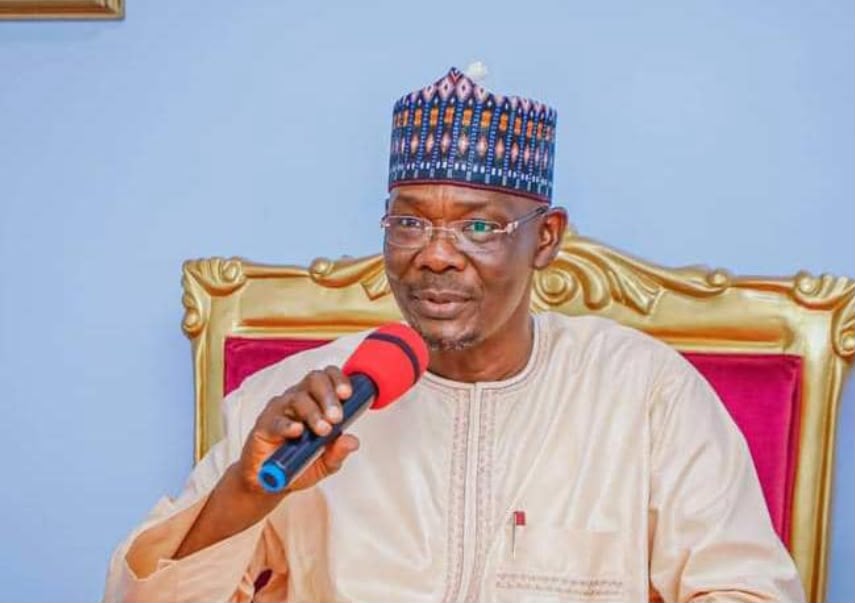
Nasarawa State Governor, Abdullahi Sule, has credited President Bola Tinubu’s economic reforms with boosting the state’s revenue and enabling his administration to execute about N90 billion worth of infrastructure projects without borrowing from banks. Sule made the disclosure at the Government House in Lafia while receiving the Renewed Hope Ambassadors Presidential Media Team, led by President Tinubu’s Special Adviser on Media and Strategy, Bayo Onanuga. The team was in the state to inspect completed and ongoing Federal Government and Nasarawa State projects.
According to Sule, the removal of the fuel subsidy and other reforms introduced by the Tinubu administration have significantly increased the funds available to state governments for development. He said Nasarawa’s monthly allocation, which previously ranged between N3.8 billion and N4.5 billion, now averages between N14 billion and N16 billion. The governor said the increase has allowed the state to undertake major infrastructure projects without relying on bank loans.
Sule recalled that Nasarawa previously struggled to raise about N5 billion through borrowing for a single market project, but now has the financial capacity to execute projects worth around N90 billion without bank financing. He urged other state governments to acknowledge the impact of the reforms on their finances.
“All the projects we are doing in Nasarawa State today, without borrowing from the bank, is as a result of President Bola Tinubu and his support. So you must give him the credit for that,” Sule said.
The governor also urged journalists to go beyond simply reporting government projects and examine the policies responsible for generating the resources used to fund them. He said the media tour was intended to help journalists understand how government policies translate into increased revenue, infrastructure development, economic opportunities and improvements in people’s lives.
“It is not just to take pictures of flyovers and pictures of this. No. It’s to understand what is driving these policies,” he said.
Sule urged journalists to examine what governors are doing with available resources and how government spending affects residents. He stressed that objective reporting, constructive criticism and recognition of positive performance were necessary to strengthen accountability and encourage leaders to deliver better results.
Major Projects Under Inspection
The media team inspected the Nasarawa State Secretariat, where the Secretary to the State Government, Dr Labaran Magaji (SAN), explained that the complex was built to bring together about 11 ministries that previously operated from scattered and dilapidated offices. He said improved revenue accruing to the state through Federation allocations helped make the project possible.
The secretariat is powered by a one-megawatt solar plant, while the state government is considering extending excess electricity to neighbouring communities and providing electric vehicle charging facilities.
The team also inspected the Shandam Road and President Bola Ahmed Tinubu Interchange, a project valued at N16 billion, before proceeding to the Emir’s Palace to assess flood-control works. The inspection also included the Wing Commander Abdullah Ibrahim Skill Acquisition Centre, a modern facility used by the Industrial Training Fund and other agencies for skills development and training.
Other projects scheduled for inspection include the Avatar Lithium Processing Plant in Nasarawa Local Government Area, described as one of Africa’s major lithium processing facilities, and the Diamond Energy Lithium Processing Plant, which was recently inaugurated by Vice-President Kashim Shettima on behalf of President Tinubu.
The team will also inspect the reconstruction of the Keffi-Nasarawa-Toto-Abaji Road, the dualisation of the Keffi-Karu-Abuja Road, and a dual overhead bridge designed to ease traffic along the corridor.
Sule earlier said the twin flyovers in Karu had helped increase property values around the area, describing the development as an example of how infrastructure can generate wider economic benefits beyond easing transportation and reducing traffic congestion.
Healthcare, Agriculture and Mining
Beyond physical infrastructure, Sule urged journalists to examine the state’s interventions in healthcare, agriculture and mining, which he described as important parts of Nasarawa’s development strategy.
In healthcare, the governor highlighted the expansion of tertiary medical services across the state’s three senatorial zones, including the State Specialist Hospital, alongside the existing teaching hospital and Federal Medical Centre.
On food security, Sule disclosed that 10,000 hectares had been committed to rice production as part of efforts to boost agricultural output.
He also highlighted the state’s expanding mining sector, particularly lithium processing, and attributed the progress to supportive Federal Government policies aimed at encouraging greater value addition within mineral-producing states.
The governor said the combination of increased revenue, infrastructure investment and development across healthcare, agriculture and mining would help create more opportunities and improve the lives of residents in Nasarawa.
Source: News Agency of Nigeria (NAN).