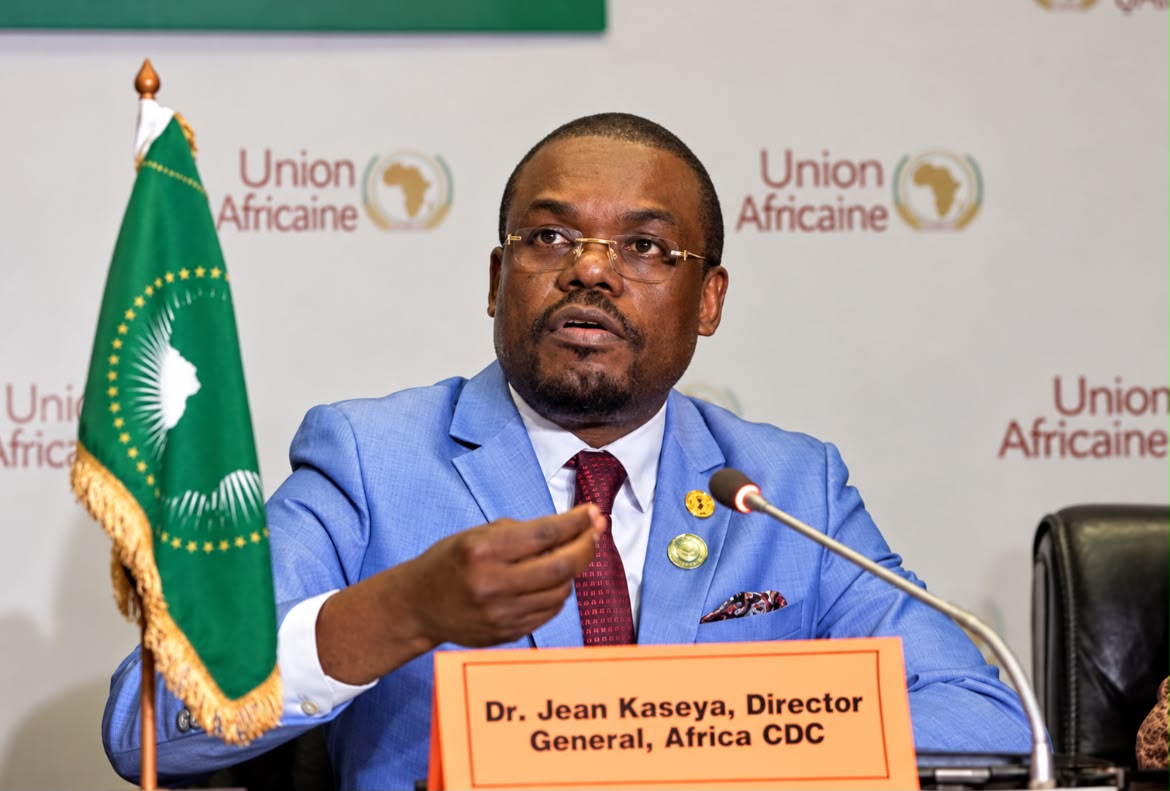
The Africa Centres for Disease Control and Prevention (Africa CDC) has warned that it will blacklist organisations that fail to account for funds received to support disease outbreak responses across the continent.
The agency’s Director-General, Dr Jean Kaseya, said African governments must know how much funding aid partners receive, how the money is spent and what activities they carry out during health emergencies.
Speaking during an interview on Channels Television’s The Morning Brief on Thursday, Kaseya expressed concern over discrepancies between the amount of outbreak funding disbursed by donors and the money disclosed by partners working with affected governments.
He said that out of the $3 billion pledged by donors at a meeting held on the sidelines of the United Nations General Assembly in September, approximately $962 million had already been disbursed.
However, during a meeting with the government of the Democratic Republic of the Congo (DRC) and aid partners, only 19 of the 92 invited organisations attended, according to Kaseya.
He said the partners who disclosed their funding reported receiving approximately $220 million, leaving questions about the whereabouts and allocation of the remaining funds.
Kaseya criticised a longstanding practice in which some organisations receive money from donors and implement activities without informing national governments of the amounts received or submitting reports on how the funds are used.
“There was a practice in many African countries, I say many, not all, but many. Partners will get money from donors. They will implement their activities without disclosing how much they got, without even sending a report to the government,” he said.
He insisted that such practices must end, stressing that governments cannot effectively coordinate outbreak responses without knowing which organisations are involved, what they are doing and how much funding they have received.
“And when the outbreak is over, we’ll hear from some capitals that billions of dollars were invested to stop this outbreak. I said, enough is enough. It will never happen again on this continent,” Kaseya added.
Africa CDC Seeks Answers Over $700 Million
The Africa CDC chief said the agency was not yet accusing any organisation of fraud or financial mismanagement but was demanding proper documentation to establish where the money had gone.
He questioned how governments could lead emergency health responses when they had information about only a fraction of the funds distributed to organisations working within their territories.
“If I see, out of $962 million disbursed, the government knows only about $220 million, what kind of government can accept to lead a response without knowing even how much they have, without knowing who’s doing what and where?” he asked.
Kaseya said his immediate priority was to establish how the remaining funds had been distributed and used before drawing conclusions about possible wrongdoing.
“Then I said, stop. I need first to know: where is the $700 million? For now we are not talking about mismanagement. For now we are not talking about fraud. No, for now we are talking about traceability; we want to know where is money?” he said.
He added that the agency was working with donors to obtain detailed information about organisations that received funding and the amounts allocated to them.
According to Kaseya, the United States was preparing to provide a list of funding recipients and their allocations, while the European Union had already shared its information with the agency.
He said concerns about fraud or mismanagement would arise if organisations could not explain how they had used the money they received.
“If today a partner got money from a donor, and the partner is unable to tell us what he did with this money, then I will start talking about fraud. Then I will start talking about mismanagement,” he stated.
Nigeria’s Ebola Response Also Under Coordination
Kaseya disclosed that the Africa CDC had already taken steps to improve coordination among organisations supporting Nigeria’s response to the Ebola case reported in the country.
He said he had instructed Professor Aliko Ahmed to work closely with Coordinating Minister of Health and Social Welfare, Professor Muhammad Pate, to coordinate partners involved in Nigeria’s response and provide daily updates to the minister.
The arrangement is intended to improve oversight and ensure that the activities and contributions of organisations supporting the response are properly communicated to the government.
The move comes as Nigerian health authorities intensify efforts to contain the reported Ebola case and prevent further transmission.
Non-Compliant Partners Face Blacklisting
Kaseya warned that organisations that refuse to comply with the Africa CDC’s transparency requirements could face exclusion from future health response activities across Africa.
He said the agency would write to African governments about non-compliant partners and raise the issue before the African Union Assembly to push for their blacklisting across the continent.
The warning signals a tougher approach to accountability in emergency health funding, with the Africa CDC insisting that organisations receiving donor money must be able to demonstrate how the funds are used.
Kaseya maintained that the immediate objective was to establish a clear record of disbursements and expenditure, adding that accusations of fraud or mismanagement should only follow if evidence emerges that organisations cannot account for their funding.