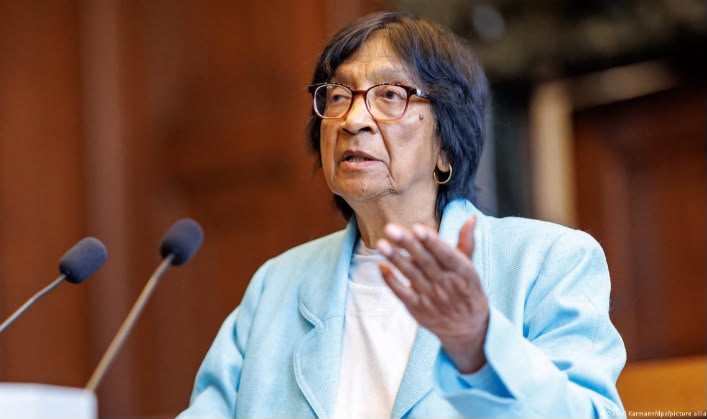
Nobel Peace Prize laureate Navi Pillay has condemned the United States’ sanctions against the International Criminal Court (ICC), describing the move as “unheard of” and “unacceptable” amid growing concerns over the future of international justice.
The 85-year-old South African lawyer and former United Nations human rights chief made the remarks on Saturday during an event at the Nobel Peace Center in Oslo, Norway. She addressed the gathering through a video link from Nuremberg, Germany.
Pillay expressed concern about increasing pressure on international judicial institutions, particularly the ICC, which is based in The Hague, Netherlands.
“There is so much tension and anxiety over the continued existence of international courts, mainly the International Criminal Court in The Hague,” she said.
She also highlighted the concerns of court employees, noting that hundreds of staff members felt threatened by the situation.
“There are hundreds of staff who feel they are under threat,” Pillay said.
Condemning the US measures, she stressed that targeting judges over their judicial decisions was unacceptable.
“Most importantly, sanctions have been announced by one country against the judges, just for the judicial orders they issue. This is unheard of, unacceptable,” she added.
US Announces Fresh Sanctions Against ICC
Pillay’s comments came a day after the Norwegian Nobel Committee announced that she had been awarded this year’s Nobel Peace Prize.
The decision drew criticism from the United States and its ally Israel. US President Donald Trump has repeatedly expressed his desire to receive the prestigious award himself.
Just hours after Pillay was named the laureate, Washington announced new sanctions against the ICC, prompting swift condemnation from several member states and the United Nations.
US Secretary of State Marco Rubio said the American government would prohibit transactions with the court, which he described as a “rogue court”.
The announcement marked a further escalation of the Trump administration’s long-running campaign against the Hague-based tribunal.
The US measures have raised concerns about the independence of international judicial institutions and the potential consequences for those involved in the court’s work.
ICC Warns That ‘History Will Judge’
The ICC rejected the sanctions, describing them as an attack on international law.
In a statement responding to the US decision, the court warned that “history will judge this moment”.
The sanctions have also drawn criticism from member states and the United Nations, adding to tensions surrounding the court’s ability to carry out its judicial responsibilities.
Pillay’s Role in International Human Rights
Beyond her service as a judge at the ICC, Pillay has held several prominent positions in international justice and human rights.
She served as the United Nations High Commissioner for Human Rights from 2008 to 2014. She also headed the UN Independent International Commission of Inquiry, which concluded last year that genocide was occurring in Gaza.
The commission’s findings do not represent an official position on behalf of the United Nations as a whole.
Israel has rejected the commission’s conclusions, describing them as “distorted and false”.
Israel and Trump Criticise Nobel Committee’s Decision
Israel strongly criticised the decision to award Pillay the Nobel Peace Prize.
The Israeli Foreign Ministry said the honour legitimised what it called “anti-Israel hatred”. It also made a remark invoking Nazi propagandist Joseph Goebbels, saying it believed he must be “applauding from hell”.
Israeli Prime Minister Benjamin Netanyahu also attacked the Nobel Committee’s decision, arguing that it had “lost its moral compass” by honouring Pillay, whom he described as “a bigot”.
Trump also condemned the committee’s choice. Last month, he had called on member states to withdraw from the ICC, and following Pillay’s announcement as laureate, he described the decision as “a disgraceful and embarrassing decision”.
Speaking at a rally with his supporters in Syracuse, New York, Trump said he had “never heard of” Pillay.
The controversy surrounding the Nobel Peace Prize decision and the latest US sanctions has intensified debate over the independence of international courts, the role of global institutions and the political pressure facing the ICC.
Source: AFP