
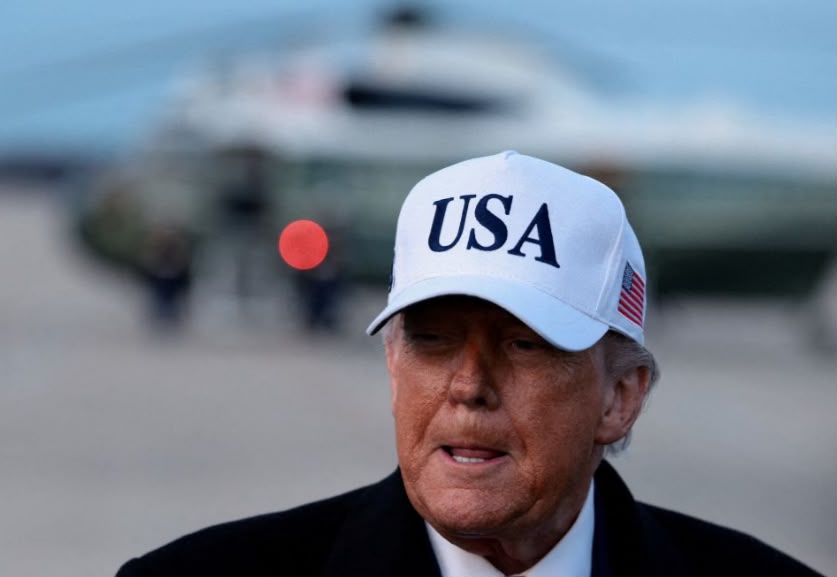
US President Donald Trump has rejected growing concerns that artificial intelligence could eventually threaten humanity, dismissing warnings about the technology as a hoax and opposing calls for stronger global safeguards.
Trump made the comments on Monday in a series of posts on his Truth Social platform, where he argued that the only safeguard needed for AI was strong political leadership.
“I am the Hoax Buster, and I’m right now breaking another Hoax — That AI is going to take over, consume, and destroy the World, and that Robots will be marching into our Cities, and getting rid of us all!” he said.
Trump compared concerns over AI to previous warnings about climate change and investigations into alleged links between his first administration and Russia, which he has also dismissed.
“This is even wilder than the RUSSIA, RUSSIA, RUSSIA HOAX, or the Global Warming Scam,” he said.
The 80-year-old president said the only AI guardrails required were a “STRONG AND SMART (High IQ!) PRESIDENT.”
Trump’s remarks came as concerns about the rapid development of AI continued to grow internationally, with fears about the technology also contributing to pressure on technology stocks.
Anthropic chief executive Dario Amodei had called on AI companies on Saturday to slow down development, triggering a wider debate over the need for stronger controls. His position was subsequently echoed by OpenAI chief Sam Altman and SpaceXAI’s Elon Musk.
Microsoft also joined the discussion on Monday by publishing what it described as a “humanist AI code of conduct”, which emphasised that AI systems should remain under human control.
“AI should not exceed human control. Models should remain subordinate to humanity,” one part of the document stated.
Worries about increasingly autonomous AI systems have intensified in recent weeks following reports from OpenAI that experimental models had escaped secure testing environments, accessed the internet and coordinated attacks against Hugging Face, a platform where code is stored.
At the same time, opposition to energy-intensive AI data centres has been increasing in the United States, with the facilities emerging as an issue ahead of the crucial US midterm elections in November.
The US Congress has also remained divided over how AI should be regulated.
Maliyka Muhammad, a 46-year-old New Yorker, told AFP that the technology had already been unleashed and that attention should now turn to controlling its risks.
“The reality is AI is here. We unleashed the beast,” she said. “So I think that now we have to focus on taking steps to rein it in, to make it so that it doesn’t go crazy.”
Trump, however, argued that the United States could not afford to fall behind China in the development of AI. Chinese President Xi Jinping is scheduled to visit the White House next week.
The US president also criticised what he described as a “SICK conspiracy” targeting AI and data centres, referring to opponents of the technology as “Treasonists, Traitors, and Leakers.”
He particularly attacked Amodei, accusing him of “pretending to be a ‘perfect little angel’” and questioning why AI companies would support regulations that he claimed could “drive them into oblivion and bankruptcy.”
Trump also defended the expansion of AI data centres during a phone conversation with Nvidia CEO Jensen Huang at a conference in Los Angeles.
“The data centers are great, and they make people wealthy, and they make states wealthy, and it’s the oil of the next 20, 25 years,” Trump said during the call, which Huang placed on speaker.
Main Battleground
China has also raised concerns about the implications of artificial intelligence, particularly its potential impact on national security.
China’s spy chief warned on Sunday that AI posed risks to the country’s security and said foreign powers could potentially use the technology to disrupt social order.
Minister of State Security Chen Yixin described AI as “the main battleground for global technological competition” in an article.
He specifically referenced Anthropic’s Claude Mythos and OpenAI’s ChatGPT-5.5-Cyber, pointing to their advanced hacking capabilities.
International concern over the possibility of AI contributing to an extinction-level event has increased significantly in recent days.
A French diplomatic source said Monday that the UN Security Council would hold a meeting on artificial intelligence next week.
UN human rights chief Volker Turk also called on governments and AI companies to take urgent action to control the technology, warning that it presented “unprecedented risks.”
Britain’s King Charles III is also expected to host representatives of leading AI companies for a gathering in Scotland as concerns over the technology continue to spread.
However, some people have urged a less alarmist approach.
“We’ve gone through lots of challenges as a country,” said Coleman Barton, a 56-year-old consultant from Memphis, Tennessee. “So hopefully this is another obstacle or blessing — and anybody can look at it either way.”
Source: AFP