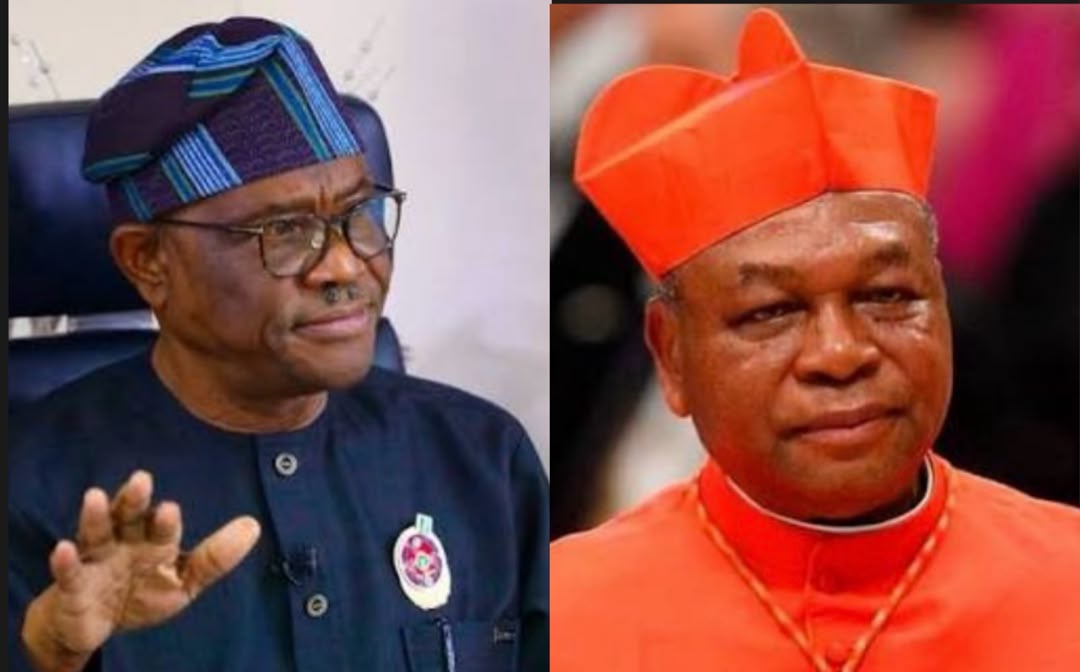
Minister of the Federal Capital Territory (FCT), Nyesom Wike, has questioned the neutrality of Cardinal John Onaiyekan, Archbishop Emeritus of the Catholic Archdiocese of Abuja, insisting that the respected cleric openly took sides during the 2023 presidential election.
Wike made the remarks during his media parley on Tuesday while reacting to the controversy surrounding Onaiyekan’s comments after the recent meeting between President Bola Tinubu and members of the Catholic Bishops’ Conference of Nigeria (CBCN).
Following the meeting, Onaiyekan said in an interview that people around President Tinubu were presenting a “rosy picture” of the country’s situation to him and suggested that the President appeared focused on securing victory in the 2027 presidential election.
His remarks drew criticism from the Presidency, which accused the Cardinal of revealing details of a private meeting and described his comments as an abuse of privilege.
Reacting to the controversy, Wike argued that religious leaders should maintain balance in their public comments, warning that consistently criticising the government without acknowledging its achievements could create the impression of political bias.
“If a religious leader is perceived or seen to be taking a side, which is very clear, it is very difficult for people to begin to see those comments as being helpful,” Wike said.
The FCT minister maintained that Cardinal Onaiyekan’s political preference was already known to many Nigerians.
“I am aware of the position of Cardinal Onaiyekan; all of us know, it’s not hidden, whom he supports; everybody knows that,” he stated.
Wike stressed that while public figures, including religious leaders, have the right to criticise government policies, such criticism should be fair and balanced by recognising areas where progress has been made.
“It’s not every time you say things are bad; nobody has heard you say government has done this well. The point I am trying to make is that, as a leader, commend government when government has done well in certain areas; criticise government and say, look, you have done this well, but you should improve in these other areas,” he said.
According to the minister, when respected leaders repeatedly make negative comments about the government without acknowledging positive developments, it becomes difficult for the government to view such criticism as objective.
He added that such interventions could easily be interpreted as politically motivated rather than constructive.
When reminded that the Catholic bishops had insisted their position was not partisan, Wike rejected the claim, arguing that many religious leaders openly supported different candidates during the 2023 general election.
“Don’t tell me they’re not partisan. You know what happened in the 2023 election. People took sides, religious leaders took sides, it was very open,” he said.
Wike insisted that it would be unrealistic to describe some religious leaders as neutral when their political preferences were publicly known.
“I would be stupid to sit here for anybody to tell me this person is impartial. No. We know ourselves in this country; we know who belongs to where. Who did they support in 2023? It was very obvious,” he added.
The latest remarks further deepen the ongoing exchange between the Presidency and sections of the Catholic Church following the bishops’ meeting with President Tinubu, which has sparked a broader debate about governance, the economy, and the role of religious leaders in Nigeria’s political space.