
By Luminous Jannamike
ABUJA — House of Representatives aspirants under the platform of the Nigeria Democratic Congress (NDC) have said that Peter Obi would be held fully accountable if elected president in 2027, warning that Nigerians would not hesitate to remove him from office if he fails to meet public expectations.
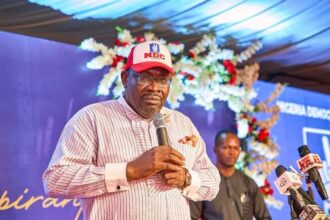
The position was made known on Friday during a press conference in Abuja, where NDC House of Representatives aspirants and members of the Coalition for the Protection of Democracy (COPDEM) outlined their vision for what they described as a people-driven, accountable and reform-oriented opposition movement ahead of the 2027 general elections.
The gathering came amid growing political realignments within the opposition camp following the recent defection of former Labour Party presidential candidate Peter Obi and former Kano State governor Rabiu Musa Kwankwaso to the NDC as coalition talks continue to gather momentum.
Speaking at the briefing, Nnamdi Iroegbu, an NDC aspirant for Aboh Mbaise/Ngor Okpala Federal Constituency of Imo State, said no government should be above scrutiny, regardless of the popularity of its leader.
According to him, accountability must remain central to democratic governance, and any administration that fails to deliver on the mandate of the people should be challenged through constitutional and democratic means.
He stressed that even a Peter Obi presidency would not be exempt from that standard.
Iroegbu said the incoming National Assembly, if Nigerians give the NDC and its allies the mandate, would operate differently from previous legislatures by placing greater emphasis on oversight, transparency and public interest.
He urged Nigerians not to become willing instruments in the hands of political actors who, in his words, have contributed to years of oppression, weak institutions and failed governance.
He also spoke on electoral credibility, expressing confidence that the 2027 elections would not witness the controversies that trailed previous polls.
According to him, the Independent National Electoral Commission (INEC) must understand that it is an independent democratic institution and not an extension of the government in power.
Obi-Kwankwaso alliance described as major political development
Also speaking at the event, Akor Christian Oche, National Youth Leader of COPDEM, described the alliance between Peter Obi and Rabiu Musa Kwankwaso as a major political development capable of reshaping the national political landscape.
He said Obi’s decision to join the NDC, alongside Kwankwaso and the broader Kwankwasiyya movement, represents what many supporters see as a strategic coalition with national appeal.
According to him, the alliance offers an opportunity to build a broader political platform that cuts across regional, ethnic and religious divides.
Oche argued that divisions in Nigeria were not created by ordinary citizens but by members of the political class who have often exploited identity politics for electoral advantage.
He described the emerging alliance — which he referred to as the “O-K Movement” — as a political partnership between the North and the South, adding that many supporters consider it a welcome development in the search for national unity and electoral competitiveness.
Conference focuses on hardship, insecurity and governance
The press conference was held under the theme “Rescue Nigeria: Consolidating Hope, Building a New Beginning.”
Participants used the occasion to highlight key national concerns, including economic hardship, rising unemployment, insecurity and what they described as declining public confidence in governance institutions.
Gambari Ismaila, an aspirant for Bwari Constituency in the Federal Capital Territory, said the political moment represents what he called a national awakening.
According to him, many Nigerians have reached a point where frustration over economic pressure, governance failures and social insecurity has turned into a renewed determination for political change.
He said citizens are increasingly rejecting a democratic culture that becomes active only during elections but fails to produce meaningful improvement in living conditions.
Ismaila added that the movement being built by the NDC and allied groups is intended to be national in outlook, drawing support from across ethnic, religious and regional lines.
He said the platform would be driven by principles of justice, equity, security and shared prosperity.
He also paid tribute to Henry Seriake Dickson, founder and National Leader of the NDC, for what he described as his role in shaping the party’s political direction.
Aspirants promise people-oriented legislature
On his part, Kingsley Ndube, an aspirant for Anaocha/Njikoka/Dunukofia Federal Constituency of Anambra State, said many of those seeking legislative office under the NDC are motivated by patriotism and national commitment rather than personal ambition.
He noted that many of the aspirants are not products of the traditional political establishment and are entering public office with the intention of strengthening accountability and responsive governance.
According to him, their goal is to build a legislature that asks critical questions, prioritises citizens’ welfare and ensures that parliamentary duties remain people-focused.
Ndube said the proposed legislative agenda of the aspirants would be rooted in service, oversight and public accountability.
He added that if elected, they intend to help shape a National Assembly that is more responsive to the needs of Nigerians and more independent in carrying out its constitutional responsibilities.
COPDEM vows continued mobilisation
Other participants at the conference said COPDEM would continue mobilising support for the opposition coalition across the country.
They maintained that the coalition is aimed at building a stronger democratic alternative capable of responding to the concerns of Nigerians and providing a more accountable political direction ahead of the 2027 elections.