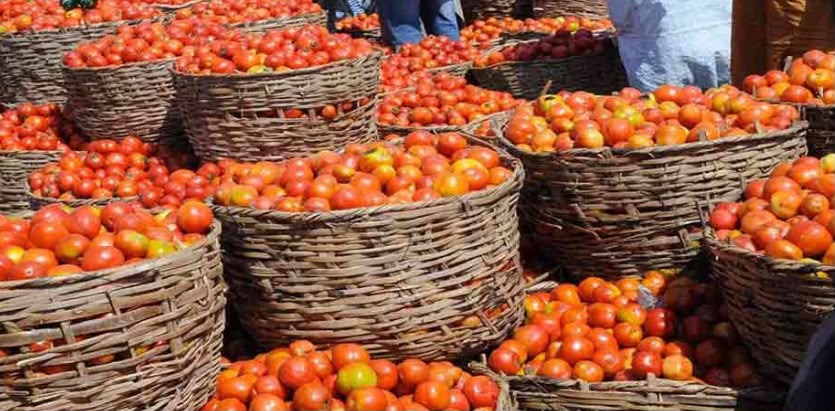
Residents of the Federal Capital Territory (FCT) are expressing growing frustration over the sharp increase in the price of tomatoes, as the staple food item becomes increasingly expensive across major markets in Abuja and its surrounding communities.
A recent survey conducted across several markets revealed that tomato prices have risen significantly in recent weeks, putting pressure on traders, families, and small-scale businesses already battling the effects of the country’s economic challenges.
Traders Count Their Losses
Many tomato sellers say the soaring prices are affecting their businesses and reducing customer patronage.
A vegetable trader at Suleja Market, Malam Isah Ado, explained that a large basket of tomatoes that previously sold for between ₦85,000 and ₦90,000 now costs as much as ₦150,000 to ₦170,000.
According to him, the increase is being driven by seasonal shortages, post-harvest losses, and the rising cost of transporting produce from farming communities to urban markets.
Another trader at Garki New Market, Philomena Bassey, said many customers wrongly believe sellers are making huge profits from the situation.
She explained that while tomatoes may be purchased at relatively lower prices from farms, transportation costs, logistics expenses, and spoilage during transit significantly increase the final market price.
Small Traders Feeling The Pressure
For many small-scale traders, the situation has become even more challenging.
A Kubwa-based trader, popularly known as Mummy Juli, said the scarcity of tomatoes has forced many sellers to adjust their pricing structures just to stay in business.
According to her, a small paint container of tomatoes that previously sold for ₦4,000 to ₦4,500 now goes for as much as ₦8,000 to ₦10,000.
She revealed that she now shares a basket of tomatoes with five other traders instead of three due to the high cost.
The trader also lamented that she can no longer sell small portions for as little as ₦100, as she used to in the past. Today, customers often need at least ₦1,000 to buy a meaningful quantity.
Families Forced To Cut Back
The impact is not limited to traders alone. Many households are also adjusting their spending habits as tomato prices continue to climb.
Mrs Angela Ikenna, a mother of two, said she now buys tomatoes only for immediate use instead of purchasing enough for the entire week.
Similarly, Moses Sunday, a nurse and resident of Abuja, noted that the increase in tomato prices is adding to the financial burden many Nigerians are already facing due to inflation and rising living costs.
For many families, tomatoes are an essential ingredient used in everyday meals, making the price increase particularly difficult to manage.
Residents Seek Government Intervention
A resident of Dei-Dei, Mrs Badia Muhammad, said many households are now turning to cheaper alternatives because tomatoes have become too expensive.
She appealed to the government to address the factors affecting tomato production and distribution, including transportation challenges, supply shortages, and post-harvest losses.
According to her, improving agricultural support and strengthening the food supply chain could help stabilise prices and make tomatoes more affordable for ordinary Nigerians.
As tomato prices continue to rise across Abuja markets, both traders and consumers are hoping for relief in the coming weeks, especially as food costs remain a major concern for many households.
Source: Adapted from a report by the News Agency of Nigeria (NAN).