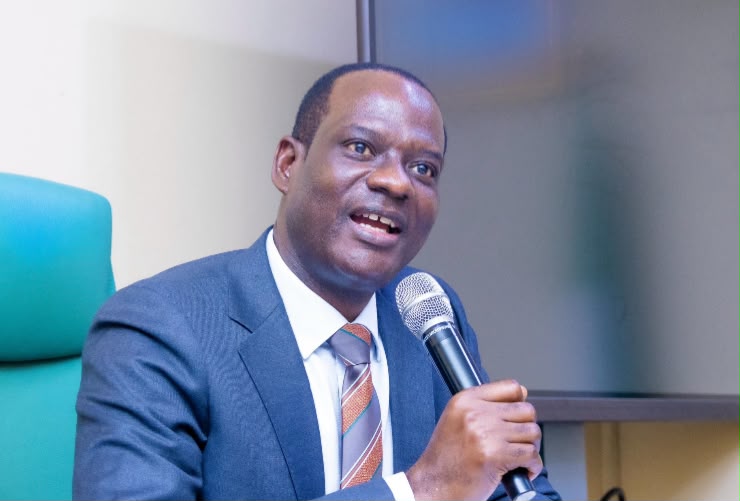
Nigeria’s Minister of Finance and Coordinating Minister of the Economy, Taiwo Oyedele, has warned that bringing back petrol subsidy could weaken the naira to between ₦3,000 and ₦4,000 per dollar, triggering a fresh round of economic challenges for Nigerians.
Oyedele issued the warning during a press briefing at the International Monetary Fund and World Bank Annual Meetings in Bangkok, Thailand, arguing that a return to subsidy could trigger capital flight, undermine investor confidence and increase pressure on the foreign exchange market.
However, the African Democratic Congress (ADC) Presidential Campaign Council has challenged the minister to provide the economic models supporting his projection, accusing the Federal Government of using fear to discourage debate about fuel subsidy.
The party’s presidential candidate, Atiku Abubakar, has promised to restore fuel subsidy if elected, saying the policy would help cushion the hardship facing Nigerians.
Oyedele Explains Why Subsidy Could Hurt the Naira
The finance minister said investors had repeatedly expressed concerns about whether the Federal Government would abandon its economic reforms ahead of the next election cycle.
He maintained that the administration of President Bola Tinubu would not reverse its reforms, warning that even a suggestion that the government was considering bringing back petrol subsidy could unsettle financial markets, increase borrowing costs and worsen economic pressures on households.
“In all the meetings I have had, I came to a conclusion that the markets, including the domestic market, which you can read from the capital market, and the international market, have largely written off the opposition in Nigeria as being unserious.
“If, for any reason, the President were to say we are merely considering the return of fuel subsidy, capital would react immediately. Air fares would struggle, the naira would come under severe pressure, potentially moving towards N3,000, N3,500 or even N4,000. The very fuel people want subsidised would become far more expensive in naira terms,” he said.
Oyedele warned that capital flight could involve not only foreign investors but also wealthy Nigerians, business owners and middle-class investors seeking to protect their money by moving into dollars.
He said such a development would increase demand for foreign exchange and ultimately affect ordinary Nigerians through higher import costs, rising prices and greater economic hardship.
The minister also dismissed suggestions that the Nigerian National Petroleum Company Limited’s temporary reduction in petrol retail margins amounted to a return to subsidy.
According to him, the move was a commercial decision rather than a payment funded with public money. He argued that a company choosing to reduce its profit margin to make a product more affordable should not automatically be described as providing or receiving a subsidy.
On May 29, 2023, Tinubu announced the removal of petrol subsidy during his inauguration in Abuja. His administration subsequently allowed the naira to float, arguing that the government budget had no provision for fuel subsidy payments from June 2023.
Tinubu Says He Has No Regrets Over Subsidy Removal
Meanwhile, President Bola Tinubu has declared that he has no regrets about removing petrol subsidy, insisting that Nigeria cannot return to what he described as “Egypt.”
The president spoke at a forum titled “Together till 2027: An Evening with Original City Boy,” organised by the City Boy Movement in collaboration with the “Relax, Tinubu Is Fixing Nigeria” movement at the Old Banquet Hall of the Presidential Villa, Abuja.
He also praised his son, Seyi Tinubu, who serves as patron of the City Boy Movement, a political support group campaigning for his re-election.
Addressing the gathering, Tinubu said the support he received from the youths reminded him why he sought the presidency and continued working to move the country forward.
He thanked his supporters for standing by his administration despite the difficult economic decisions taken over the past three years.
The president also criticised opposition politicians promising to restore fuel subsidy, using the biblical and Quranic account of Moses leaving Egypt to argue that Nigeria should not return to its previous economic situation.
“You cannot ask Moses to go back to Egypt. We wake up with ideas, original thoughts and deep thinking to move this country forward. With your energy and support, we will never go back to Egypt.
“No regrets. Before I left home, I saw one of the greatest Chinese economic news reports, that the economy was growing by about 4.6 per cent. We are on the right trajectory. We are in good company. The economy is growing steadily. You will have a future, a future to believe in,” Tinubu said.
He urged Nigerians to support his administration, insisting that the country’s future depended on maintaining the current reform direction.
Tinubu said his government inherited serious financial difficulties, including limited foreign reserves, unpaid obligations to airlines and excessive currency printing.
He maintained that rather than dwell on the problems inherited from his predecessor, he accepted responsibility and introduced reforms, including changes to the tax system.
The president also recalled his promise to address prolonged strikes by the Academic Staff Union of Universities (ASUU), saying the government wanted university students to complete four-year courses within four years.
He praised young Nigerians who had continued to support his administration despite criticism, adding that the City Boy Movement had built a political structure with members across states, local governments, wards and polling units.
Tinubu said the group had also established a call centre to engage young Nigerians and a support initiative known as City Boy Care.
He described the movement’s activities as evidence of organisation rather than mere political noise and thanked youth support groups in Nigeria and abroad for promoting his administration.
The president further assured young supporters that they would not be left behind, stressing that the country’s future belonged to their generation.
He also defended the Nigerian Education Loan Fund (NELFUND), stating that more than one million students had received support through the initiative.
Praising his son’s involvement in youth mobilisation, Tinubu urged him to do more and continue serving as an example to younger Nigerians.
He also encouraged young people to ensure that eligible voters obtained their Permanent Voter Cards and participated in elections.
Shettima Says Nigeria Could Have Faced Economic Collapse
Vice President Kashim Shettima also defended the administration’s economic policies, arguing that Nigeria’s economy could have collapsed if Tinubu had not taken what he described as far-reaching decisions.
Shettima credited the reforms with helping to reposition the economy and said Nigeria recorded economic growth of 4.43 per cent in the last quarter, while foreign reserves were hovering around $60 billion.
He argued that those criticising the administration would have been discussing a collapsed economy if the president had avoided difficult decisions.
The vice president acknowledged that Nigerians had endured economic hardship but insisted that the situation could have been worse without the reforms.
He also expressed confidence that the government would introduce measures to address agricultural challenges and bring down food prices in the coming weeks.
Shettima cited investments in infrastructure and the Nigerian Education Loan Fund as part of the administration’s efforts to improve the economy.
He urged young Nigerians to communicate the government’s position to other citizens and encourage support for its policies.
ADC Demands Economic Model Behind ₦4,000/$ Projection
However, the ADC Presidential Campaign Council has rejected Oyedele’s warning, demanding that the finance minister publish the economic model used to predict that restoring petrol subsidy could push the naira to ₦4,000 per dollar.
The council’s Director of Media and Publicity, Kola Ologbondiyan, accused the Federal Government of using alarming projections to discourage Nigerians from debating the merits of fuel subsidy.
Speaking to Vanguard, Ologbondiyan said the government should provide evidence to support its claims rather than rely on warnings about possible economic consequences.
“The Minister of Finance is merely scaremongering. He cannot claim that a return to fuel subsidy will cause the naira to depreciate to ₦4,000 to the dollar without showing Nigerians the model behind that projection,” he said.
Ologbondiyan also questioned the government’s reliance on investor concerns, demanding that officials identify those making the projections and explain how they arrived at the predicted exchange rate.
“They should show Nigerians who is making these claims and explain how they arrived at an exchange rate of ₦4,000 to the dollar if fuel subsidy is reintroduced,” he said.
The ADC representative further argued that Nigeria was not the only country to consider or operate a production subsidy, insisting that the proposal should be assessed on its economic merits instead of being dismissed through dire predictions.
“I do not believe this projection is realistic. It is fantasy,” he said.
The disagreement highlights the growing political debate over whether Nigeria should maintain its current fuel subsidy policy or consider restoring some form of support to ease the cost of living.
While the Tinubu administration maintains that subsidy removal and other reforms are necessary to stabilise the economy, the ADC says the government’s warnings about the naira require evidence and should not prevent public debate.