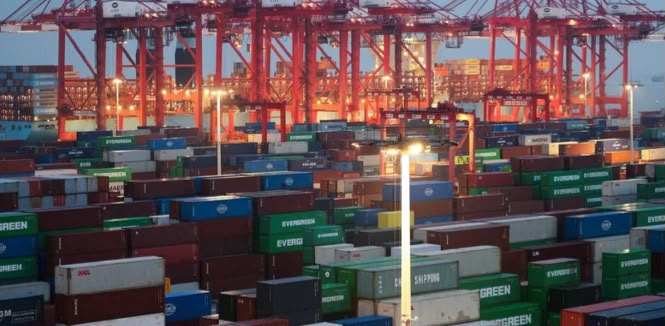
China’s economic growth picked up in the third quarter of 2026, recovering from a three-year low as strong exports offset weak domestic consumer spending, although analysts warn that the country’s increasing dependence on overseas demand is creating economic imbalances.
The economy grew by 4.5 per cent during the quarter, beating analysts’ forecasts. Economists expect Beijing to meet its full-year growth target of 4.5 to 5 per cent without introducing additional major stimulus measures, supported by strong growth earlier in the year and recent government assistance.
However, data released on Monday showed that retail sales continued to lag behind industrial production, while China’s property market remained in a prolonged downturn that has significantly reduced household wealth over the past five years.
Combined with recent figures showing weak consumer inflation and exports rising by more than a third, the data suggest that China is strengthening its position in global markets while struggling to generate stronger economic prosperity at home.
Weak domestic demand has forced some businesses to shift their focus towards international markets. Zhang Chao, who manages Southeast Asian operations for a company manufacturing motorbike headlights, said his firm had almost abandoned domestic sales as overseas orders doubled this year.
“It’s too competitive and there’s no profit,” Zhang said of the Chinese market. “The barrier to entry is a bit lower overseas.”
Low consumer demand has intensified price competition among businesses, forcing companies to cut costs, including reducing payroll expenses.
The economic pressure has also affected workers. Laura Shi, who lost her sales job in June, travelled across China during the country’s week-long October national holidays but slept in her car on most nights to save money on accommodation.
“The downside was that I couldn’t shower, and there was noise outside,” she said.
China’s growing dependence on exports has also raised concerns among its international trading partners.
The European Union and China have agreed to limit hybrid car exports to the European market, while Brussels is considering further restrictions after data showed that China’s September trade surpluses with Germany and France each increased by more than 200 per cent year-on-year.
ANZ analysts warned that China’s latest growth figures highlighted deeper challenges in balancing its economy over the medium term.
“This year’s growth figures highlight a deeper rebalancing challenge for the medium term,” the analysts said in a note on Monday.
“Rising trade tensions, protectionist measures and geopolitical frictions pose significant risks to future growth,” they added, warning that China’s economy was more exposed to external developments than policymakers would prefer.
Meanwhile, the Chinese yuan strengthened on Monday to its highest level since July 2022.
Exports Drive China’s Economic Growth
China is on course to exceed its $1.2 trillion trade surplus recorded last year, despite rising trade tensions around the world.
Exports of products ranging from chicken meat and beauty products to electric vehicles and prefabricated homes have increased significantly.
Some manufacturers that previously moved production overseas are also returning to China as US tariffs on Chinese goods become closer to those imposed on competitors such as Vietnam.
Andy Ji, an analyst at ITC Markets, said China’s industrial development was becoming increasingly competitive, particularly in advanced manufacturing and technology.
“High-tech manufacturing, chip output, new energy vehicles, and export delivery values reflect a competitive industrial upgrading that is real and accelerating,” Ji said.
However, he warned that the country’s growth remained heavily dependent on exports and government-led activity, while domestic consumption continued to struggle.
“However, the growth composition remains deeply unbalanced… Growth is export- and state-led. Domestic demand is not yet self-sustaining, and the property sector shows no floor,” he added.
China’s industrial output increased by 5.5 per cent in September.
Statistics bureau official Mao Shengyong described the country’s 4.6 per cent growth during the first nine months of 2026 as “hard won”, while acknowledging that development remained uneven and inadequate.
He said high-end manufacturing, the digital economy and modern services contributed more than 40 per cent of economic growth during the period.
Despite the positive figures, Beijing has introduced additional support measures, highlighting continuing concerns about weakness outside the manufacturing sector.
Measures announced since late September include cheaper credit for infrastructure and technology projects, modest mortgage subsidies and additional funding for local governments.
Financial pressures on local governments have contributed to a 7.2 per cent decline in fixed-asset investment between January and September.
Economists believe the latest measures could help China meet its annual growth target, but say the support remains heavily focused on production rather than household consumption.
Societe Generale economist Michelle Lam warned that China’s export growth could eventually face limitations.
“China’s export expansion is not without limits,” Lam said.
“Without a decisive policy shift toward supporting household incomes and consumption, China is likely to remain trapped in a prolonged period of low inflation and sub-par growth,” she added.
Households and Businesses Continue to Feel the Pressure
Weak consumer demand remains a major concern despite the country’s strong export performance.
During the October national holidays, average spending per trip fell to its lowest level in four years. Meanwhile, complaints on social media about demanding work schedules, low salaries and inadequate labour protections have become more frequent.
Retail sales increased by 1.1 per cent in September, marking their fastest growth in six months, although the increase came from a low base.
In the eastern city of Ningbo, a restaurant owner surnamed Dai said customers were increasingly bringing their own wine instead of purchasing drinks from the restaurant’s menu.
“Everyone is cutting jobs these days,” Dai said. “Sometimes I wonder whether I should let one or two staff members go and do more work myself.”
China’s unemployment rate edged down to 5.2 per cent in September. However, economists warned that the figures might not fully reflect the difficulties facing workers because of the expansion of gig employment.
Under the measure cited in the report, anyone working at least one hour a week is considered employed.
In Hangzhou, 26-year-old accountant Carol Huang expressed frustration after her employer almost halved her bonus.
However, she said she was reluctant to leave because comparable jobs in the city paid between 3,000 and 6,000 yuan ($449-$897) per month, significantly less than her current earnings.
“What on earth happened to the job market?” Huang asked.
The figures underline China’s challenge of sustaining economic growth while strengthening domestic consumption, improving household incomes and reducing its dependence on exports.