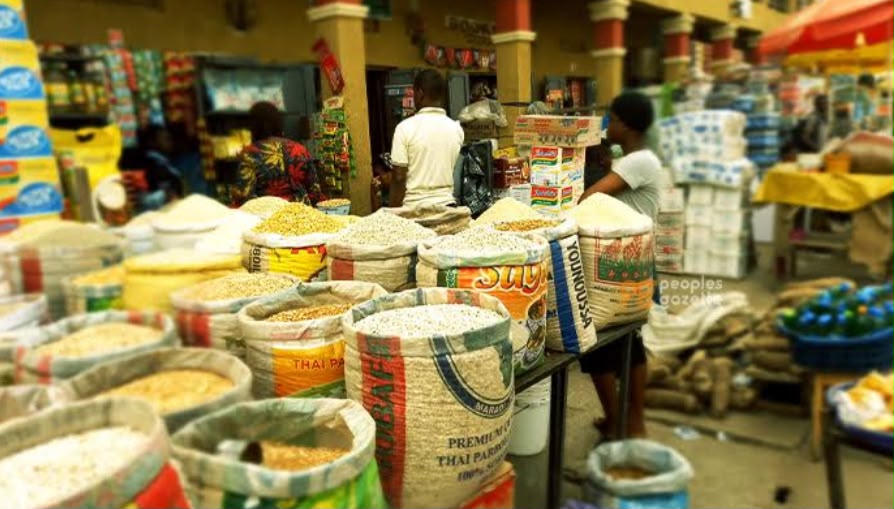
Nigeria spent $1.19 billion on food imports in the first half of 2026, representing an increase of $121.52 million, or 11.41 per cent, compared with the $1.07 billion recorded during the same period in 2025.
The increase comes despite government efforts to boost domestic agricultural production and reduce the country’s dependence on imported food.
An analysis of the Central Bank of Nigeria’s (CBN) Quarterly Statistical Bulletin for the second quarter of 2026 showed that foreign exchange spending on food imports increased year-on-year in five of the six months reviewed, with February being the only month that recorded a decline.
The figures highlight Nigeria’s continued reliance on foreign food supplies and the pressure this places on foreign exchange demand.
In January 2026, forex spending on food imports rose to $232.05 million from $213.11 million recorded in January 2025, representing an increase of 8.89 per cent.
However, spending declined by 22.90 per cent in February to $150.87 million from $195.68 million in the corresponding month of the previous year.
The decline was followed by a recovery in March, when spending increased to $153.73 million from $141.30 million recorded in March 2025.
April recorded the sharpest year-on-year increase, with forex utilisation rising by 54.28 per cent to $217.74 million from $141.13 million a year earlier.
Spending continued to rise in May, reaching $220.26 million compared with $202.83 million in May 2025, an increase of 8.59 per cent.
In June, food import spending climbed by 23.92 per cent to $212 million from $171.08 million recorded in the same month of the previous year.
The increases recorded between April and June more than offset the decline in the first quarter, pushing Nigeria’s total food import bill higher during the six-month period.
On a quarterly basis, forex spending on food imports fell by 2.57 per cent in the first quarter of 2026 to $536.65 million from $550.79 million in the corresponding period of 2025.
However, spending rose sharply in the second quarter, increasing by 26.38 per cent to $650 million from $514.34 million recorded in the same period of the previous year.
The second-quarter increase accounted for the overall rise in food import spending during the first half of 2026.
The development comes as the Federal Government continues to pursue agricultural policies aimed at increasing local food production and reducing reliance on foreign supplies.
However, stakeholders in the agricultural sector have identified insecurity, abandoned farmlands and the limited adoption of modern farming technology as major obstacles to improving domestic output.
The President of the Association of Small Business Owners of Nigeria, Femi Egbesola, recently attributed Nigeria’s continued dependence on imported food to insecurity and inadequate technological adoption in agriculture.
According to him, insecurity has forced many farmers to abandon their farms, disrupting the supply of agricultural produce to manufacturers and other users of locally sourced raw materials.
“Most of the farmers are no longer on the farms because of insecurity. Many farmlands have been deserted. That is where the primary products come from. It is when the farmers plant and harvest. That is when the manufacturers and other users can buy from them and use them as their inputs. This time, many of the farms are deserted,” Egbesola said.
He also noted that agricultural productivity in Nigeria remained below global standards because many farmers still depend on outdated tools and farming methods.
Egbesola urged the government to introduce more technology into agriculture, improve smallholder farmers’ access to modern equipment and invest in mechanisation to increase production.
The Emir of Kano, Muhammadu Sanusi II, has also warned that large-scale food imports could weaken local agricultural production and threaten Nigeria’s long-term food security.
Sanusi argued that opening the Nigerian market to imported food, including rice from Thailand, had weakened local rice mills and left banks struggling with bad loans linked to investments in the agricultural value chain.
He acknowledged that food imports helped reduce prices following the removal of the petrol subsidy but warned that the policy had exposed local producers to competition that threatened their businesses.
The emir called on the government to support low-income households without undermining domestic farmers and agricultural businesses through excessive dependence on imported food.
He made the remarks at the Sustainable Table Series held at the Federal Palace Hotel, Victoria Island, Lagos, on Thursday.
Sanusi stressed the need for governments to prioritise nutrition, education, infrastructure and productive investment as part of efforts to improve economic development.
He maintained that making food affordable for low-income households should not come at the expense of domestic production, arguing that the government could protect vulnerable citizens while supporting local farmers and businesses.
The latest CBN figures highlight the challenges facing Nigeria’s drive for food self-sufficiency, as spending on imported food continues to rise despite efforts to strengthen domestic agricultural production.