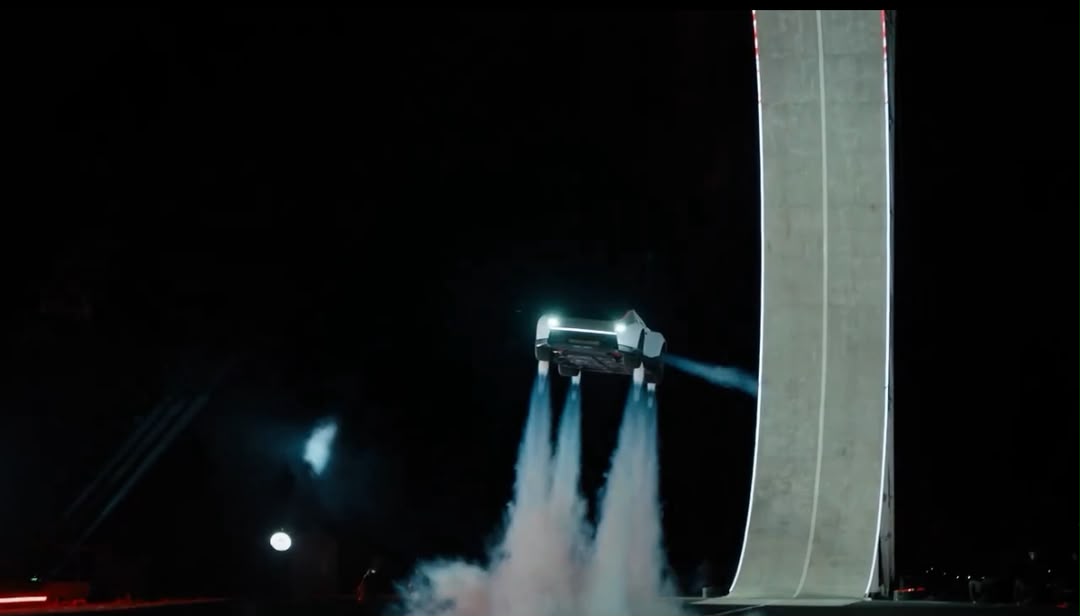
Tesla CEO Elon Musk has unveiled a new sports car he describes as a “flying” vehicle, attracting attention with a demonstration that saw the car launch from a steep ramp before landing on its wheels.
The demonstration took place on Thursday at a SpaceX test facility in Texas and was livestreamed on Tesla’s official X account.
During the event, Musk presented the new Roadster, a sports car designed with technology that he said would allow it to propel itself into the air.
“Flying cars are real,” Musk declared during the presentation.
The billionaire entrepreneur explained that the vehicle would use “ultra high-pressure air tanks” to generate the thrust needed to lift it off the ground.
However, Musk acknowledged that the project still carried some uncertainty, admitting that its success was not guaranteed, although he believed it would probably work.
He described the development as the result of collaboration between Tesla, the electric vehicle manufacturer, and SpaceX, his rocket and spacecraft company.
“The vehicle would go into production in 2028,” Musk said, outlining the expected timeline for the ambitious project.
Despite the excitement surrounding the unveiling, flying cars have faced significant technical and regulatory obstacles, preventing the technology from becoming widely available.
One of the major challenges is developing vehicles that can operate safely in the air while meeting aviation regulations and addressing concerns about noise, reliability and public safety.
The idea of a flying car is not entirely new. American aviation pioneer Glenn Curtiss demonstrated an early flying car prototype in 1917.
However, the concept has attracted renewed interest in recent years as advances in electric motors, batteries and other technologies have created new possibilities for personal air transportation.
Musk’s latest announcement adds to the growing interest in combining the automotive and aerospace industries. Nevertheless, questions remain about whether the Tesla Roadster will achieve its proposed flying capabilities and meet the requirements needed for commercial production.
For now, the company has indicated that production is planned for 2028, although the vehicle’s ultimate success remains uncertain.