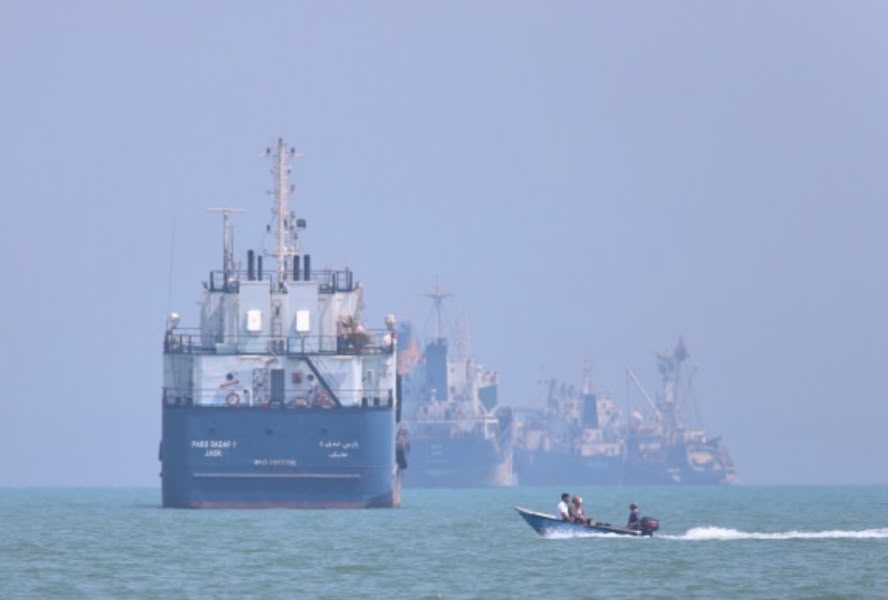
The risk facing oil tankers in the Strait of Hormuz is increasing as Iran warns that it could block additional routes used to transport oil through the strategically important waterway.
The latest threats have already affected shipping activity, with the number of vessels attempting to pass through the strait falling to its lowest level in more than two months.
The situation has become more tense after a series of attacks on tankers, with last week recording the highest number of such incidents since the war involving Iran began.
A senior regional official close to Tehran told Reuters that Iran had warned countries in the region that attempts to establish alternative routes for exporting oil would be viewed as hostile.
Another senior regional diplomat, who had been briefed by Tehran, said Iran was determined to maintain control over the waterway.
“Iran has absolutely no intention of allowing control of the Strait of Hormuz to slip from its hands, and has plans ready to block routes that some regional countries have for exporting oil,” the diplomat said.
According to the diplomat, Iran could use missiles, drones or patrol boats to disrupt shipping and discourage vessels from using certain routes.
“This could involve missile and drone attacks on ships, or sending boats to scare ships away,” the diplomat said. “It plans to continue this policy of fear and threats.”
The warnings come as Gulf oil producers have been looking for ways to move crude through less exposed routes.
In recent months, some shipments have been moved through channels close to Oman’s side of the Strait of Hormuz before being transferred farther out in the Gulf of Oman, with support from US aircraft, according to shipping sources.
Tanker Hit Near Qatar
The risks became more apparent after a tanker was reportedly struck by projectiles in the waters near Qatar.
The British maritime security agency UKMTO said projectiles hit a tanker approximately 51 nautical miles off Qatar within the Gulf.
Maritime security sources identified the vessel as the Acers, an Antigua and Barbuda-flagged chemical tanker. Multiple projectiles reportedly struck the ship north of Qatar’s Madinat ash Shamal, with members of its crew suffering minor injuries.
The incident has raised concerns that the conflict could spread further into waters used by major energy-producing countries.
“The Acers strike raises the prospect of a wider combat area affecting approaches to Qatar, Bahrain, Saudi Arabia, Kuwait and Iraq,” maritime risk intelligence group Pole Star Global’s subsidiary Clearwater Dynamics said in a report.
The ship’s listed operator, Valvoria Shipping, could not immediately be reached for comment.
Shipping operators are also becoming increasingly cautious about sending vessels through the Strait of Hormuz.
“The recent spate of Iranian attacks seems to have dampened the appetite of shipowners to sail through the Strait,” said Jakob Larsen, chief safety and security officer at shipping association BIMCO.
“The Iranian threat appears to have increased,” he added.
Global Oil Supply Under Pressure
The growing danger around the Strait of Hormuz comes as the wider conflict continues to affect global energy markets.
US President Donald Trump is considering his next steps towards Iran, including whether further military action should take place before or after the November midterm elections, while the US maintains pressure on Tehran through a naval blockade.
The conflict is also placing a heavy financial burden on the United States, with the war reportedly costing about $3 billion each month.
Governments and energy companies have been drawing on oil reserves to help compensate for disruptions to global supplies.
However, industry executives meeting at a forum in London warned that readily available oil stocks are becoming increasingly limited, leaving the global market more vulnerable to further shocks.
The disruption is also spreading beyond the energy sector.
Danish shipping company Maersk announced that it would increase its emergency fuel surcharge on inland transportation in the United Kingdom and Ireland because of the continuing conflict in the Middle East.
Speaking at a UK Chamber of Shipping conference in London, Major General Paul Maynard, Assistant Chief of the Naval Staff with Britain’s Royal Navy, warned that the consequences of the conflict would extend beyond the waters where the fighting is taking place.
“There is no going back to the old world, no harboring back to the stability and the prosperity of the last several decades,” Maynard said.
“A war at sea does not remain at sea.”
With tanker traffic already falling and threats against shipping increasing, the Strait of Hormuz remains a major flashpoint for global energy supplies, with any further disruption potentially putting additional pressure on oil markets and the wider global economy.