Oil prices fell on Wednesday after US President Donald Trump said American and Iranian representatives had held what he described as “very good” and “very productive” talks at the United Nations. The comments raised expectations that diplomatic efforts could ease tensions in the Middle East and reduce pressure on global energy markets.
International benchmark Brent crude dropped below the $100-per-barrel mark, while US benchmark West Texas Intermediate (WTI) also traded below the symbolic level. In afternoon Asian trading, Brent reached $98.41 per barrel, while WTI fell to $89.23.
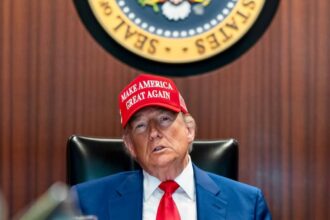
Trump said the three-hour meeting had gone well and indicated that another meeting between the two sides was expected soon.
“The three-hour meeting was ‘very good’, ‘very productive’ and ‘they have another one scheduled in the very near future’,” Trump said.
The comments came only hours after Trump addressed the United Nations General Assembly, where he said he faced a major decision over whether to reach an agreement with Iran or take military action.
The latest movement in oil prices reflects how closely energy markets are watching developments between Washington and Tehran. Investors have been concerned that continued conflict and disruption around key shipping routes could restrict global oil supplies.
The situation has also affected the Strait of Hormuz, a crucial route for global energy shipments. Meanwhile, Saudi Arabia has indicated that it is preparing to restart operations along its East-West Pipeline, an important export route that allows crude to reach the Red Sea without passing through the Strait of Hormuz.
The pipeline was shut following drone attacks that damaged pumping stations. Its reopening could provide another route for Saudi crude exports, although the amount of additional oil that would immediately reach international markets remains uncertain.
Market analysts said the US-Iran talks were important because they introduced the possibility of a diplomatic solution after months of heightened tensions.
At the same time, uncertainty remains over the direction of the conflict and its impact on global energy supplies. Any deterioration in negotiations or renewed disruption around major oil-shipping routes could put fresh pressure on crude prices.
The oil market was not the only area affected by developments in the Middle East. Asian stock markets were mixed, while European markets opened higher.
Hong Kong’s Hang Seng Index fell by one per cent, while Shanghai’s Composite Index closed 0.4 per cent lower. South Korea’s Kospi rose 0.9 per cent and Taiwan’s Taiex gained 0.8 per cent.
Investors were also watching developments involving China, with a planned meeting between Trump and Chinese President Xi Jinping expected to focus on trade between the world’s two largest economies.
The US-China trade relationship remains another major concern for financial markets, as both countries have maintained a tariff truce but have yet to reach a permanent agreement.
Analysts also said China’s potential influence over Iran could become important as diplomatic efforts continue.
“But the higher impact issue will be the war in the Middle East and any support the US can extract from China to use its leverage to sway the Iranians,” said Kyle Rodda, senior financial market analyst at Capital.com.
Key market figures around 0215 GMT showed WTI down 1.4 per cent at $89.23 per barrel, while Brent North Sea crude was down 0.9 per cent at $98.41 per barrel.
Source: AFP