
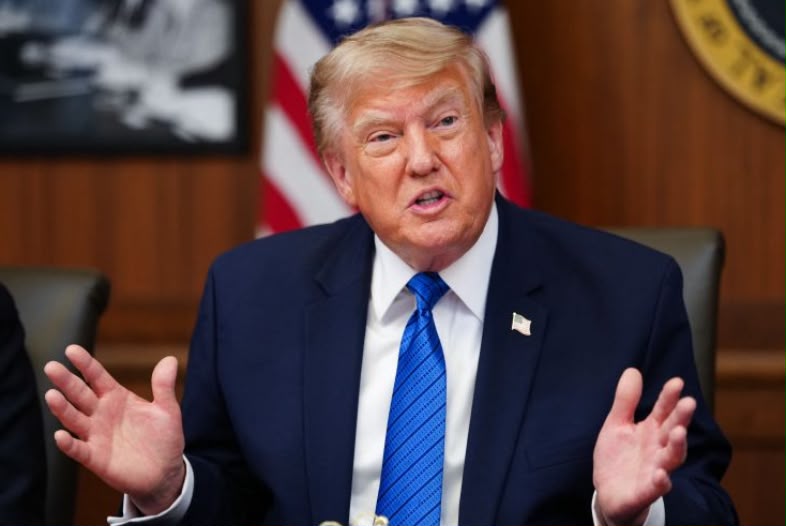
United States President Donald Trump has warned Iran to reopen the strategically important Strait of Hormuz, saying Tehran could face severe military consequences if ongoing negotiations fail.
Speaking to reporters in California on Tuesday, Trump expressed optimism that an agreement could be reached within days, saying discussions had made significant progress.
“We had a very good day,” Trump said, adding that a deal to reopen the Strait of Hormuz could happen “tomorrow or the next day.”
However, the U.S. president struck a much tougher tone during an interview with Fox News, warning that Washington would not tolerate a prolonged blockade of one of the world’s busiest energy shipping routes.
“The strait is going to be open very soon, or they’re going to get hit very hard — and then the strait’s going to be open,” Trump warned.
“All you can do is fight your way out.”
The Strait of Hormuz is one of the world’s most critical maritime routes, with a significant portion of global crude oil and liquefied natural gas exports passing through the narrow waterway each day. The route has remained a major point of tension since fighting between Iran and the United States escalated earlier this year.
According to reports, Iran has tightened its control over the strait following the conflict that began on February 28, with Tehran seeking greater authority over maritime traffic, including plans to charge tolls for vessels passing through the waterway—powers it did not exercise before the conflict.
The dispute over Hormuz has become one of the biggest obstacles to broader negotiations between both countries and has contributed to renewed hostilities despite an earlier ceasefire reached in April.
U.S. Treasury Secretary Scott Bessent also expressed optimism that negotiations could produce positive results within days.
“There is a chance we may have a deal,” Bessent told CNBC, suggesting an agreement could be reached by Wednesday or Thursday.
Reports by Axios, citing regional and U.S. officials, indicate that the United States, Iran and Oman are close to reaching an interim 60-day agreement that would allow the safe passage of ships through the Strait of Hormuz.
According to the report, Washington hopes to officially announce the arrangement as early as Wednesday if negotiations are successfully concluded.
Despite the optimism from Washington, Iran’s Foreign Ministry has publicly denied holding direct negotiations with the United States, even as Trump continues to insist that talks are ongoing.
Meanwhile, U.S. Secretary of State Marco Rubio confirmed that Washington is involved in diplomatic efforts alongside Oman aimed at increasing shipping traffic through the strategic waterway.
Qatar, which has also been playing a mediation role, said diplomatic efforts remain active but clarified that no direct Iran-U.S. talks are currently scheduled.
Qatar’s Emir, Sheikh Tamim bin Hamad Al-Thani, also held a telephone conversation with President Trump on Tuesday, with officials confirming that both leaders discussed ongoing efforts to reduce tensions in the region.
Trump has repeatedly maintained that the United States is seeking two key outcomes from the negotiations—the reopening of the Strait of Hormuz and the denuclearisation of Iran.
While acknowledging that Iran’s nuclear issue could take longer to resolve, Trump warned that existing U.S. measures against Tehran would remain in place unless an agreement is reached.
“A Deal, or Total Surrender,” Trump said, describing the possible outcomes.
The security situation in the region remains highly volatile.
On Tuesday, Britain’s United Kingdom Maritime Trade Operations (UKMTO) confirmed that an unnamed commercial vessel was struck by an unknown projectile while sailing through the Strait of Hormuz near the coast of Oman. One crew member was reported missing following the attack.
In a separate incident, an Indian cargo vessel, MSV Faize Noore Oliya, sank in the Red Sea after coming under attack. Although the attackers were not officially identified, all crew members were successfully rescued.
The Red Sea has become increasingly important for global shipping as disruptions in the Strait of Hormuz continue.
However, vessels using the route also face threats from Iran-backed Houthi rebels in Yemen, who have declared a maritime blockade and claimed responsibility for several attacks on commercial ships since the conflict
intensified.
The continued instability across both waterways has heightened concerns over global energy supplies andinternational trade, as the Strait of Hormuz remains one of the world’s most vital oil transportation corridors.
Source: AFP.