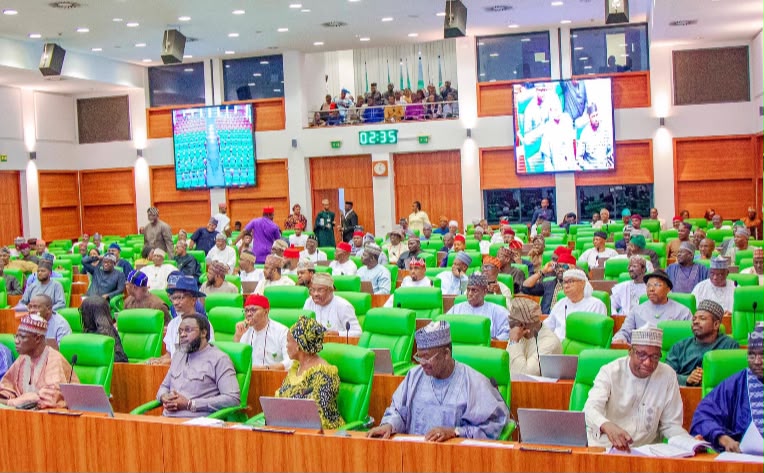
A heated debate broke out in the House of Representatives on Wednesday after lawmakers disagreed over a proposal to invite President Bola Tinubu to explain the slow implementation of the 2025 budget and delays in releasing funds to Ministries, Departments and Agencies (MDAs).
The motion, sponsored by Alex Mascot Ikwechegh, highlighted concerns over poor budget execution, stalled government projects and unpaid contractors despite funds approved by the National Assembly.
According to Ikwechegh, several ministers and heads of MDAs admitted during the ongoing 2026 budget defence sessions that many agencies received little or no capital funding throughout the 2025 fiscal year.
He also noted that numerous contractors have been left struggling after executing government projects with borrowed funds but are yet to receive payment.
While acknowledging President Tinubu’s earlier directive to settle verified contractor debts estimated at ₦1.5 trillion, the lawmaker argued that implementation had remained slow.
He further criticised a recent Treasury circular that suspended payments for constituency projects pending additional verification, warning that it could create fresh delays.
The debate became more intense after Ikwechegh proposed that President Tinubu be invited to the House to explain why budgeted projects were not being implemented.
“We want to use this opportunity to invite the President of the Federal Republic of Nigeria… to explain to the Nigerian people why projects are not being implemented despite trillions of naira appropriated,” he said.
The proposal sharply divided lawmakers, with some backing the invitation while others argued that ministers and heads of government agencies—not the President—should be held accountable for budget implementation.
The disagreement soon escalated into shouting matches across the chamber as members exchanged opposing views.
Despite the tension, Speaker Tajudeen Abbas restored order and ruled against separating the motion for individual votes, directing the House to proceed according to its parliamentary rules.