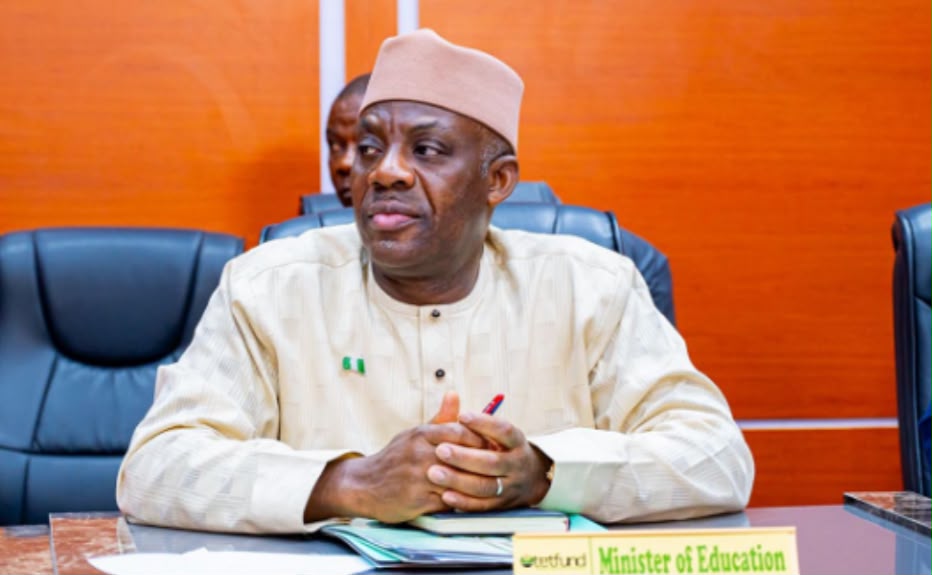
The Federal Government has reaffirmed that education will be at the heart of President Bola Ahmed Tinubu’s plan to build a $1 trillion economy, unveiling reforms aimed at producing a highly skilled workforce, expanding healthcare training and improving the quality of higher education across Nigeria.
Minister of Education, Dr. Tunji Alausa, disclosed this during an interview over the weekend, saying the administration is overhauling the education sector to equip young Nigerians with the skills needed to compete globally and contribute to the country’s economic growth.
According to him, the government’s investment in education and human capital development is designed to position Nigeria as a leading source of skilled professionals for both Africa and the international labour market.
“We want to be the manpower supplier of the world. We need to produce competent, skilled, and educated young Nigerians who will drive our economy, contribute to Africa’s growth, and compete successfully across the world,” Alausa said.
As part of the reforms, the minister revealed that annual admissions into nursing schools have increased from about 20,000 to nearly 50,000 students, while enrolment into medicine, pharmacy and dentistry programmes has also been expanded.
He said the move is aimed at addressing Nigeria’s shortage of healthcare professionals and ensuring that more qualified personnel enter the workforce in the coming years.
Alausa stressed that President Tinubu’s vision of transforming Nigeria into a $1 trillion economy cannot be achieved without significant investment in education.
“As the president advances his vision of building a one trillion-dollar economy, education will remain at the center of that transformation,” he stated.
The minister also assured Nigerians that the Nigerian Education Loan Fund (NELFUND) was deliberately designed to remain sustainable beyond the life of the current administration.
According to him, President Tinubu has consistently instructed ministers and heads of government agencies to implement reforms that will continue to benefit Nigerians long after the present government leaves office.
“There is no value in introducing policies that cannot stand the test of time. Sustainability is central to this administration’s philosophy, and that principle guided the design of NELFUND,” Alausa explained.
On industrial relations, Alausa credited the administration with restoring stability to Nigeria’s tertiary education sector through continuous dialogue with academic and non-academic unions.
He noted that the government fulfilled key commitments, including the payment of 50 per cent of withheld salaries inherited from previous disputes and the approval of nearly a 40 per cent salary increase for workers in tertiary institutions.
The minister said the improved relationship between the government and university unions has helped reduce disruptions in the academic calendar and enhance the performance of higher institutions.
Highlighting recent progress, Alausa said the number of Nigerian universities recognised in the Times Higher Education World University Rankings increased from 21 to 24, with public universities reclaiming the country’s top positions.
He described the achievement as evidence that ongoing reforms are improving the quality and global competitiveness of Nigeria’s higher education system.
Reaffirming the government’s commitment, Alausa said the Ministry of Education will continue implementing policies that expand access to quality education, strengthen human capital development and prepare young Nigerians for opportunities in the global economy.
He maintained that under President Tinubu’s Renewed Hope Agenda, education will remain the foundation for sustainable economic growth and national development.