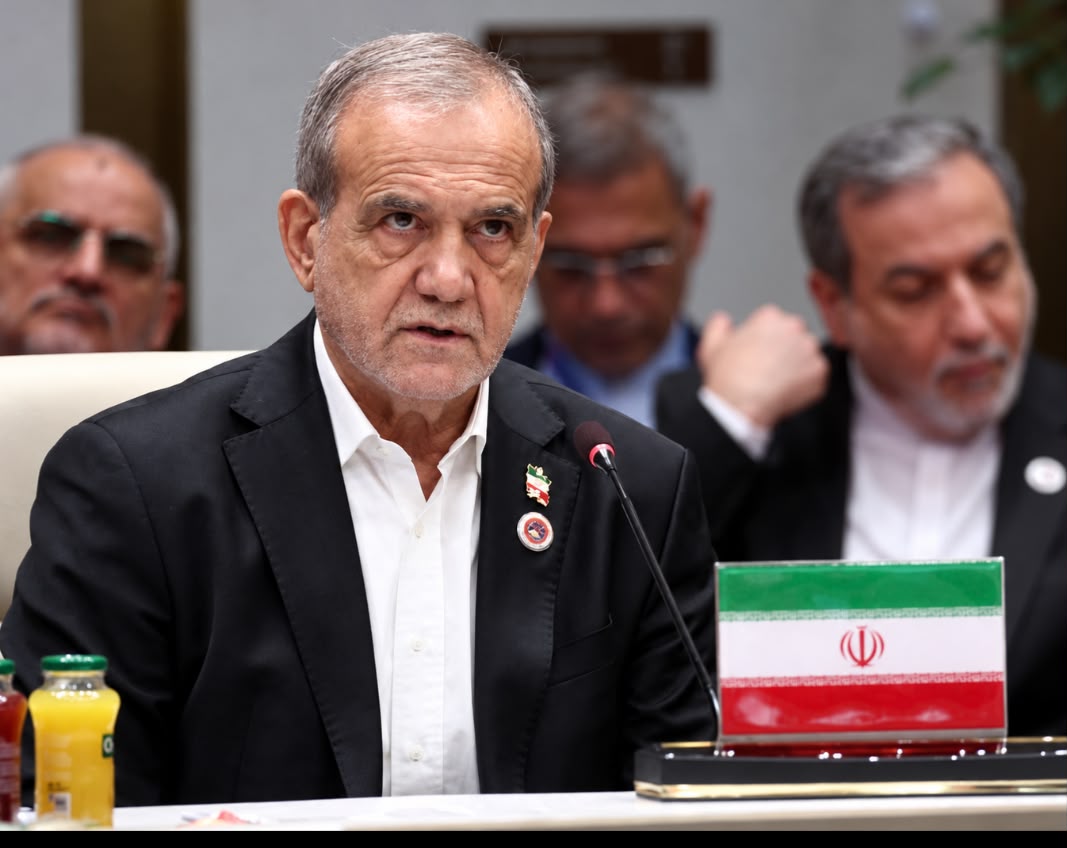
Iranian President Masoud Pezeshkian has warned that efforts to end the ongoing Middle East war will struggle to succeed unless negotiations are conducted without threats, coercion or political pressure.
Speaking on Friday at a regional summit in Turkmenistan, Pezeshkian stressed that meaningful dialogue requires mutual respect and a willingness by all parties to honour their commitments.
“Dialogue holds meaning and a chance of success only when based on mutual respect and mutual commitments, and when devoid of pressure and threat,” he said during his address at the Commonwealth of Independent States (CIS) summit.
He also questioned the value of negotiations conducted under military pressure, arguing that such discussions amount to forcing one side to accept the demands of another.
“Negotiation conducted in the shadow of force is not negotiation, it is imposition and coercion,” the Iranian president said.
Pezeshkian further warned that sanctions imposed on Iran could have wider consequences for the region, affecting “regional trade, connectivity, energy, and order.”
Iran Questions Value of Negotiations With US
The Iranian president’s latest remarks follow his statement on Monday that negotiations with the United States had become pointless because they had failed to prevent further attacks.
“With an enemy that everyday resorts to assassination, sanctions, pressure and threats, and that breaks its commitments, negotiations are meaningless,” Pezeshkian said.
The conflict began in late February with US and Israeli attacks on Iran, which came while Washington and Tehran were engaged in negotiations over Iran’s nuclear programme.
In June, the opposing sides agreed to a memorandum of understanding outlining a framework for a permanent resolution to the conflict. However, tensions escalated again after Iranian attacks on vessels in the Strait of Hormuz prompted the United States to resume military operations.
Since then, efforts to reach a lasting agreement have remained largely stalled. Recent indirect discussions between Washington and Tehran, held on the sidelines of the United Nations General Assembly, also failed to produce a breakthrough.
US Turns to Economic Pressure as Talks Stall
The United States has reduced its military operations in recent weeks and increasingly relied on economic pressure against Tehran. Washington has not carried out a strike against Iran since September 1, according to the report.
The US and Israel have maintained that their military campaign is necessary to prevent Iran from developing nuclear weapons. Tehran, however, has repeatedly denied seeking to acquire such weapons.
With diplomatic efforts struggling to make progress, attention has increasingly turned to the Strait of Hormuz, a critical international shipping route whose closure has sent shockwaves through global energy markets.
Strait of Hormuz Remains a Major Point of Conflict
Iran has sought to assert control over the strategic waterway since the war began, attacking vessels attempting to pass through without its authorisation.
The United States has responded with a counterblockade targeting Iranian ports and has also attacked vessels it accuses of violating the restrictions.
The dispute over the Strait of Hormuz has added to the economic consequences of the conflict, particularly because of the waterway’s importance to global energy supplies.
Pezeshkian’s latest comments suggest that Tehran remains opposed to negotiations conducted under military or economic pressure. However, with previous diplomatic efforts failing to secure a lasting agreement, the path towards ending the war remains uncertain.
Source: AFP