The National Chairman of the All Progressives Congress (APC), Nentawe Yilwatda, has claimed that several politicians who benefited from President Bola Tinubu’s support in previous years abandoned him when he declared his intention to contest the 2023 presidential election.
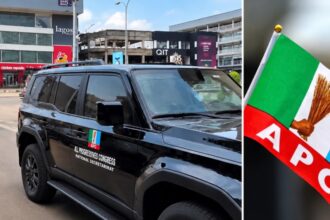
Yilwatda made the statement on Friday at the APC national secretariat while welcoming politicians who defected from opposition parties in Sokoto, Kaduna, Jigawa, Kano and Plateau states.
He argued that despite losing the backing of several political allies, Tinubu eventually secured victory in 2023 because Nigerians recognised his political record and contributions to national unity.
“People that he has supported all through from the North and South, when he said he wanted to contest, most of them pulled out their support,” Yilwatda said.
He also praised Tinubu for what he described as his role in defending democracy, claiming that the president had demonstrated a strong commitment to Nigeria’s unity.
Welcoming the defectors, the APC chairman said their decision to join the ruling party reflected confidence in Tinubu’s leadership and his Renewed Hope Agenda.
“Let me welcome all of you to our great party and thank you for taking this decisive action. You are not just changing a platform, but you are coming in to join us in reinforcing our belief in President Bola Ahmed Tinubu and his Renewed Hope Agenda,” he said.
Yilwatda Lists Tinubu’s Support for Northern Politicians
Yilwatda highlighted several presidential elections in which he said Tinubu had supported northern politicians, presenting the moves as evidence of his commitment to national unity.
He recalled that in 2007, Tinubu supported former Vice-President Atiku Abubakar’s presidential ambition because he believed political power should shift from the South to the North.
“If anybody has worked for the unity of Nigeria, it is President Bola Ahmed Tinubu. President Bola Ahmed Tinubu, in 2007, supported Atiku to become the president of Nigeria because he believed then that power should move from the South to the North,” Yilwatda said.
He also cited the 2011 election, claiming that Tinubu supported Nuhu Ribadu, who contested under the Action Congress of Nigeria (ACN).
According to Yilwatda, Tinubu mobilised political support for Ribadu because he believed the northern candidate should have an opportunity to lead the country.
The APC chairman further recalled Tinubu’s support for former President Muhammadu Buhari in 2015, saying the decision was influenced by the need to maintain national unity following the death of former President Umaru Musa Yar’Adua.
He added that Tinubu remained committed to Buhari in 2019, when some northern political leaders reportedly withdrew their support, and helped lead reconciliation efforts to unite supporters behind the former president.
Yilwatda used these examples to argue that Tinubu had repeatedly supported political figures from outside his region.
APC Chairman Defends Tinubu’s Northern Projects
The APC leader also rejected criticism that Tinubu had done little for northern Nigeria, pointing to several road and rail projects that he said were under development.
He mentioned the Abuja–Kaduna–Kano road, the Kano–Maiduguri road and rail connections involving Kano, Maradi and Kaduna.
Yilwatda argued that critics were overlooking infrastructure investments intended to benefit northern communities.
“Most times, they deceive you. They say, ‘What has President Bola Ahmed Tinubu done for the North?’ They keep on saying that,” he said.
Defending the projects, he added: “Why did he spend that kind of infrastructure in the South? He’s doing it for us, and we said he has done nothing for us.”
He also criticised opposition figures over their statements about port operations, saying he had heard Atiku claim that the president had blocked all the ports.
“We forgot when we opened those ports long ago. They don’t even read the news. They don’t even follow what’s happening in the country,” Yilwatda said.
Yilwatda Questions Opposition’s Proposed Fuel Discount
The APC chairman also challenged the opposition’s proposal to introduce a N500-per-litre discount on petroleum products.
He argued that implementing the proposal would cost approximately N20 trillion annually, which he described as nearly half of Nigeria’s national budget.
Yilwatda further questioned whether the government had sufficient crude oil resources to sustain such a policy, claiming that about 60 per cent of Nigeria’s oil production was under joint ventures in which the Federal Government owned only a portion.
“How do you make a promise of what you don’t have?” he asked.
He also criticised Atiku over the privatisation of public assets, making claims about the sale of major industrial facilities.
Yilwatda said the Aluminium Smelting Company in Akwa Ibom was built at a cost of approximately $3.5 billion but was sold for less than $130 million.
He also claimed that the steel facilities in Ajaokuta and Delta were each built for about $1.5 billion, alleging that the Delta facility was sold for $30 million.
Condemning the transactions, he said: “Away with that man that sold out the future. 3.5 billion for just less than 130 million, 1.5 billion for 30 million.”
The figures and allegations were presented by Yilwatda during his address.
APC Welcomes More Opposition Candidates
The event also featured the presentation of politicians who had defected from opposition parties to the APC.
A party member, Dr Princess Aslam Aliyu, said she had brought 12 African Democratic Congress (ADC) House of Assembly candidates into the ruling party approximately two weeks earlier.
At Friday’s event, she presented another 11 House of Representatives and House of Assembly candidates from the Nigeria Democratic Congress (NDC) and the ADC.
Aliyu said the candidates’ participation in the electoral process could be verified through records maintained by the Independent National Electoral Commission (INEC).
“These are not merely defections; they are clear demonstrations of confidence in President Bola Ahmed Tinubu, GCFR, and the Renewed Hope Agenda as a pathway to national recovery,” she said.
She added: “In two weeks, we are bringing 23 opposition candidates back to the APC. If politics is a contest of influence, then our scoreboard currently reads two-zero in our favour.”
APC Denies Plans to Make Nigeria a One-Party State
The party’s National Secretary, Senator Ajibola Basiru, also addressed concerns that the APC was seeking to turn Nigeria into a one-party state.
He maintained that the ruling party did not have such an ambition, although he argued that its political activities and organisational strength could attract more members.
“So, most of the time, when they say APC wants to turn Nigeria into a one-party state, we are not. That’s not our aspiration,” Basiru said.
He added that if the party’s efforts resulted in further political gains, the APC could not deny those outcomes.
Basiru also criticised ADC vice-presidential candidate Rotimi Amaechi over reported comments concerning a proposed seaport project in Ogun State.
He questioned Amaechi’s reported objection to the project, arguing that infrastructure development should not be dismissed on political grounds.
“How can you say that a developmental project, which is being embarked on in support of a leading economy, should not have been done because we want to politicise it?” Basiru asked.
Basiru Rules Out Return of Fuel Subsidy
Basiru also defended the Tinubu administration’s decision to end the fuel subsidy regime, insisting that the government would not reverse the policy.
“We are not going back to subsidy. It’s gone and gone forever,” he said.
He further defended the Nigerian Education Loan Fund (NELFUND), claiming that more than 1.4 million students had benefited from the scheme.
The APC national secretary criticised former senator Dino Melaye for questioning the N20,000 monthly allowance provided to beneficiaries, arguing that the government also covers students’ tuition fees separately.
The event ended with APC leaders presenting the defections as evidence of growing support for Tinubu ahead of the 2027 general elections, while defending the administration’s policies on infrastructure, fuel subsidy and education.