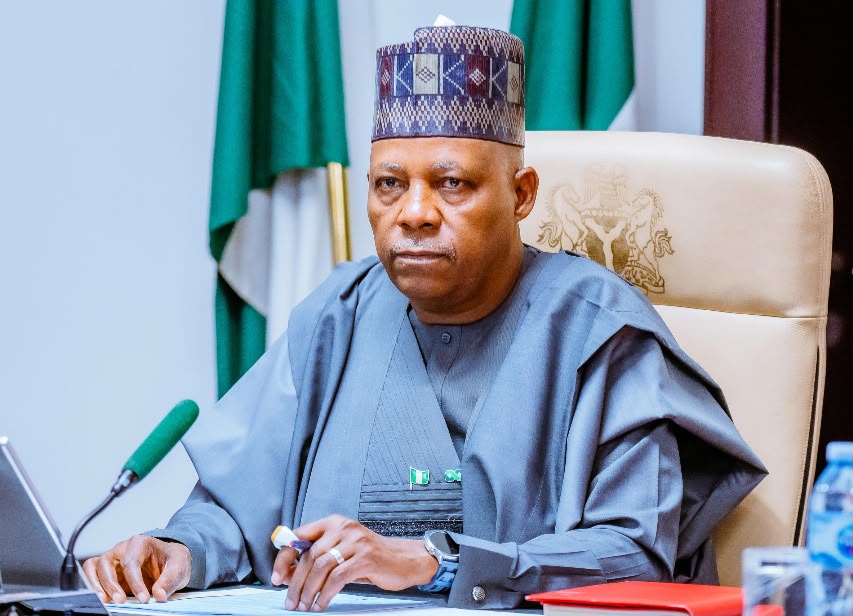
Vice President Kashim Shettima has said Nigeria’s oil blocks are now being awarded through transparent and competitive processes, giving the example of a friend who secured an upstream asset without relying on political connections.
Shettima spoke on Tuesday in Abuja while representing President Bola Tinubu at the fifth anniversary of the Nigerian Upstream Petroleum Regulatory Commission (NUPRC).
According to the Vice President, the ongoing reforms in Nigeria’s upstream petroleum sector are creating a more open environment for investors and reducing the influence of political connections in the allocation of oil assets.
“A friend of mine with no connection whatsoever got awarded an upstream location through a fair and just process,” Shettima said.
He maintained that the Federal Government wants Nigeria to become a preferred destination for long-term investment in the oil and gas industry, assuring investors that the rules would remain clear while compliance and accountability would be enforced.
Shettima said the Petroleum Industry Act (PIA), enacted in 2021, had helped end years of uncertainty in the sector by providing clearer regulations for investors and increasing the role of host communities in petroleum-producing areas.
He also credited the National Assembly, particularly former Senate President Ahmed Lawan, for helping to drive the passage of the legislation.
“Five years ago, the PIA brought to an end two decades of waiting,” he said, adding that the law provided investors with clearer rules and a more predictable framework.
The Vice President said the creation of the NUPRC was part of the reforms introduced by the PIA and that the commission had played an important role in strengthening regulation, improving production and restoring confidence in Nigeria’s upstream sector.
He noted that the country had previously suffered significant crude oil losses due to theft and vandalism but said production had become more stable through the combined efforts of security agencies, host communities, operators and the regulator.
“Only a few years ago, our oil and gas fields were losing a large share of their output to theft and vandalism. Today, through the joint effort of our security agencies, operations, host communities and the Commission, production is steady and stronger,” Shettima said.
He further highlighted the role of host communities in maintaining peace around oil-producing areas, noting that more than 170 communities had benefited from projects in areas such as education and healthcare.
On investment, Shettima said the government was taking steps to reduce the high costs and lengthy contracting processes that have historically discouraged investors from developing petroleum projects.
He pointed to recent presidential directives and executive orders aimed at improving the fiscal and regulatory environment, including incentives for upstream operators and deep offshore developments.
According to him, the Deep Offshore Oil and Gas Project Incentive Tax Remission Order 2026 is expected to help unlock up to $50 billion in new investment, beginning with the Bonga South-West project.
“Some of Nigeria’s largest discoveries are in our deep offshore. And many of them were immediately dismissed because every project had to be negotiated on its own terms,” he said.
Shettima said the new framework was intended to replace what he described as an uncertain negotiation process with clearer criteria for investors.
“Our message to the world is simple: Nigeria is open for long-term investment and terms are clear,” he added.
The Vice President charged the NUPRC to maintain transparency, provide predictable timelines and work with other government agencies to reduce regulatory conflicts.
He also warned that companies receiving government incentives would be expected to fulfil their obligations, including commitments on work programmes, local content, environmental protection and host communities.
“The PIA is a strong foundation, but the foundation is only the beginning. Laws set the rules. Investors sign commercial agreements. Policy, however sound on paper, is only useful when implemented. And that responsibility weighs heavily on the Commission,” Shettima said.
He added that the government would continue pursuing reforms aimed at attracting long-term investment while using oil and gas revenues to support economic diversification.
Shettima also stressed the importance of gas development, saying Nigeria’s significant gas reserves could support electricity generation, industrial expansion and efforts to reduce emissions.
“This is the decade of gas. With the largest gas reserve in Africa, and one of the largest in the world, we will expand gas supply to power industry and economic growth, reduce methane emissions and grow renewable energy alongside it,” he said.
He urged the NUPRC to maintain its commitment to transparency and effective regulation as it begins its next five years, stressing that the commission has a major role to play in turning government policies into increased investment and production.