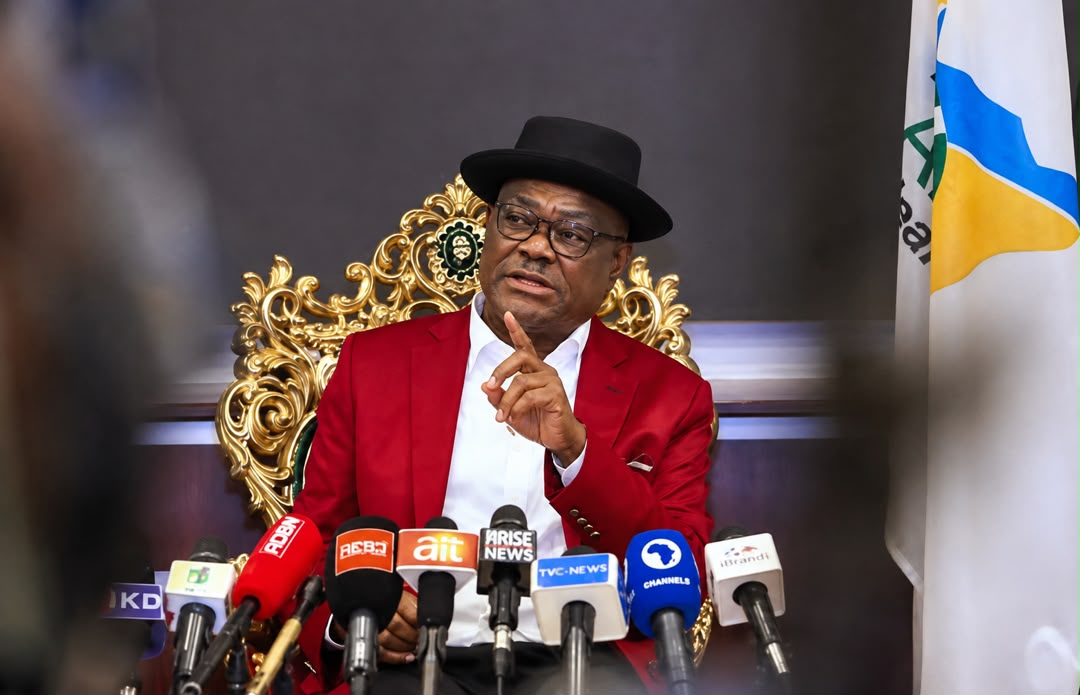
Minister of the Federal Capital Territory (FCT), Nyesom Wike, has questioned the Catholic Bishops’ Conference of Nigeria (CBCN) over its call for the Independent National Electoral Commission (INEC) to remain neutral ahead of the 2027 general election, insisting that such claims should be backed by evidence.
Speaking during a media chat in Abuja on Tuesday, Wike said the Catholic Bishops, being a respected religious body, should be careful not to make allegations capable of undermining public confidence in the electoral process without presenting verifiable facts.
“How did the Catholic Bishops come to the conclusion that INEC is biased? What are your facts? What happened for you to prove?” Wike asked.
He argued that public statements from influential organisations such as the Catholic Bishops carry significant weight and could shape public perception if not properly substantiated.
“When you come to the public to make that kind of accusation that the electoral umpire is biased, you must have your facts. But if you just come to the general public and say INEC is biased, you are sending a signal to the public because people will say, ‘For a whole Catholic Bishops to say INEC is biased, then something is wrong.’ We must be very careful about it,” he said.
Wike’s comments followed the recent meeting between President Bola Tinubu and the leadership of the Catholic Bishops’ Conference of Nigeria (CBCN) at the Presidential Villa in Abuja, where the bishops urged the President to ensure that the 2027 general election is free, fair and credible while calling for stronger democratic institutions.
The bishops’ appeal came amid concerns from opposition parties, which have repeatedly alleged that INEC and some government institutions are being used to intimidate political opponents.
Responding during the meeting, President Tinubu dismissed the allegations, insisting that the electoral commission remains impartial.
“INEC is neutral. They’ve never, never intimidated anybody. If political opponents are crying wolves, maybe they are afraid of their own shadows and the uncertainty in the companies they keep, not me,” Tinubu said.
The President also declared that while he is prepared for political competition ahead of the next election, he would not make the contest easy for his opponents.
“I asked for this job. I’m in it. Those who will take it from me will try. They will try. All is fair in politics and it’s equal opportunity,” he added.
The controversy deepened after Cardinal John Onaiyekan, the Archbishop Emeritus of Abuja, disclosed in an interview that President Tinubu appeared unhappy with the message delivered by the bishops during the meeting. According to the cleric, the bishops informed the President that many Nigerians are facing severe economic hardship and that the country is “bleeding.”
His remarks drew criticism from the Presidency, with presidential spokesman Daniel Bwala accusing the Cardinal of playing politics.
Bwala argued that Onaiyekan’s position did not represent the views of all Christians in Nigeria and further alleged that the Catholic Church was sympathetic to Peter Obi and his political ambition ahead of the 2027 election.
Wike echoed similar sentiments, suggesting that Cardinal Onaiyekan’s political preference was already known.
“I’m aware of Cardinal Onaiyekan’s position. It’s not hidden who he supports. Everybody knows that,” the FCT minister said.
The latest exchange has further intensified public debate over the role of religious leaders in political discourse, the neutrality of INEC and preparations for the 2027 general election, as different stakeholders continue to express contrasting views on the country’s democratic process.