
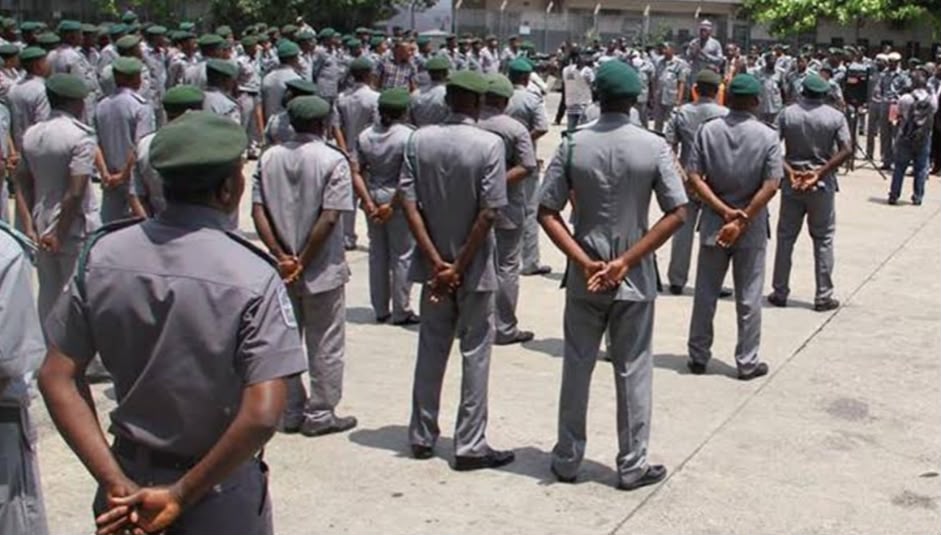
The Nigeria Customs Service (NCS) has released the final list of successful candidates for its 2024/2025 recruitment exercise, announcing that only 3,852 applicants were selected from a total of 573,680 applications received nationwide.
The announcement was made on Tuesday by the Comptroller-General of Customs, Adewale Adeniyi, during a press briefing, where he described the recruitment process as thorough, transparent and merit-based. He also apologised for the delay in releasing the final list and disclosed that the Service would now conduct recruitment exercises annually to create more opportunities for Nigerians.
According to Adeniyi, the successful candidates were recruited into three different cadres of the Service, comprising 1,275 officers in the Superintendent Cadre, 367 officers in the Inspectorate Cadre, and 2,210 officers in the Customs Assistant Cadre.
“I am pleased to announce the release of the final list of successful candidates in the 2024/2025 Recruitment Exercise of the Nigeria Customs Service. This is the final list, and it concludes the exercise that opened in December 2024,” he said.
Explaining why the recruitment process took several months to complete, Adeniyi said the huge number of applications, verification exercises and staff turnover within the Service contributed to the delay.
He noted that every application underwent several stages of screening, including computer-based examinations, credential verification and identity checks against the national identity database to ensure only qualified candidates made the final list.
“Every candidate on this list has passed through several distinct layers of scrutiny. Where a record did not reconcile, we went back and checked it again. Successful candidates will now proceed to physical and medical assessment before the final Board review,” he explained.
The Customs boss stressed that the recruitment process was conducted without favouritism despite pressure from different quarters, insisting that every successful applicant earned their place through merit.
The statistics released by the Service showed just how competitive the exercise was. Out of 573,680 applicants, only 3,852 secured employment, representing an overall success rate of 0.67 percent, or roughly one successful candidate out of every 148 applicants.
Competition varied across the three cadres. The Superintendent Cadre received 276,995 applications for 1,275 vacancies, translating to one successful applicant for every 217 candidates. The Inspectorate Cadre recorded the highest competition, with 128,604 applicants battling for just 367 positions, representing one successful candidate for every 350 applicants. Meanwhile, the Customs Assistant Cadre attracted 168,081 applications for 2,210 vacancies, giving a success ratio of one in 76.
Adeniyi also addressed the hundreds of thousands of unsuccessful applicants, urging them not to lose hope because many met the recruitment requirements but could not be accommodated due to the limited number of available positions.
“I want to speak directly to the more than 560,000 Nigerians whose names are not on this list. You were not rejected; you were unlucky in a field of extraordinary competition. Many of you met every requirement. There were simply not enough places,” he said.
He encouraged unsuccessful applicants to keep their credentials updated and apply again, announcing that the 2026 recruitment exercise would commence later this year under a newly introduced annual recruitment system.
On state representation, the Comptroller-General said the recruitment reflected Nigeria’s federal character, with all 36 states and the Federal Capital Territory (FCT) represented.
According to him, each state received 105 recruitment slots, comprising 35 positions in the Superintendent Cadre, 10 in the Inspectorate Cadre and 60 in the Customs Assistant Cadre, while the FCT received 72 slots based on the approved allocation formula.
The distribution by geopolitical zones showed that the North West received 735 slots, the North Central got 702, while the North East, South South, and South West each secured 630 positions. The South East received 525 slots, reflecting the number of states in each zone.
The Customs Service also released a breakdown of gender representation in the exercise. Out of the 3,852 successful candidates, 839 were women, representing 21.8 percent of the total intake.
Adeniyi explained that women accounted for 21.2 percent of all applications, meaning their success rate slightly exceeded their application rate.
According to him, female applicants performed particularly well in the Inspectorate and Customs Assistant cadres, although the physically demanding enforcement roles attracted fewer female applications.
The Comptroller-General added that the Service intends to encourage more qualified women to apply for enforcement roles in future recruitment exercises.
On the age profile of the successful candidates, Adeniyi disclosed that the recruitment focused mainly on young Nigerians, with the median age standing at 26 years. He explained that nearly three-quarters of those recruited are below 30 years, positioning the Service to build a technologically driven workforce capable of adapting to modern customs operations over the coming decades.
Adeniyi further announced that the Nigeria Customs Service has officially adopted an annual recruitment cycle, ending the previous system where recruitment was conducted after several years.
“Recruitment will no longer be an occasional event undertaken every several years. It will now be a standing, predictable yearly process. The 2026 Recruitment Exercise will open later this year, and it is my intention that it will be completed within a single calendar year,” he stated.
He advised successful candidates to monitor only the official communication channels of the Nigeria Customs Service for further instructions regarding physical screening and medical examinations.
The Customs boss also warned applicants to ignore fraudsters demanding money in exchange for recruitment offers.
“Recruitment into the Nigeria Customs Service is free. No candidate has paid, and no candidate should pay any person or group for a place on this list. Anyone who solicits payment on our behalf is a criminal and should be reported immediately,” he warned.
The release of the final recruitment list brings the 2024/2025 exercise to a close while opening the door for a new annual recruitment system expected to begin later this year.